U.S. banks are moving closer to issuing dollar-backed stablecoins after the Federal Deposit Insurance Corporation (FDIC) approved a proposed rule that sets out U.S. banks are moving closer to issuing dollar-backed stablecoins after the Federal Deposit Insurance Corporation (FDIC) approved a proposed rule that sets out

U.S. Banks Cleared to Issue Stablecoins as FDIC Moves to Implement GENIUS Act

U.S. banks are moving closer to issuing dollar-backed stablecoins after the Federal Deposit Insurance Corporation (FDIC) approved a proposed rule that sets out how FDIC-supervised institutions can apply to do so under the GENIUS Act, a stablecoin law signed earlier this year.

The proposal marks the FDIC’s first concrete step toward implementing the legislation and shows a broader shift in how U.S. regulators are bringing digital payment instruments into the traditional banking system.

The FDIC’s Stablecoin Blueprint: Who Gets In, Who Stays Out
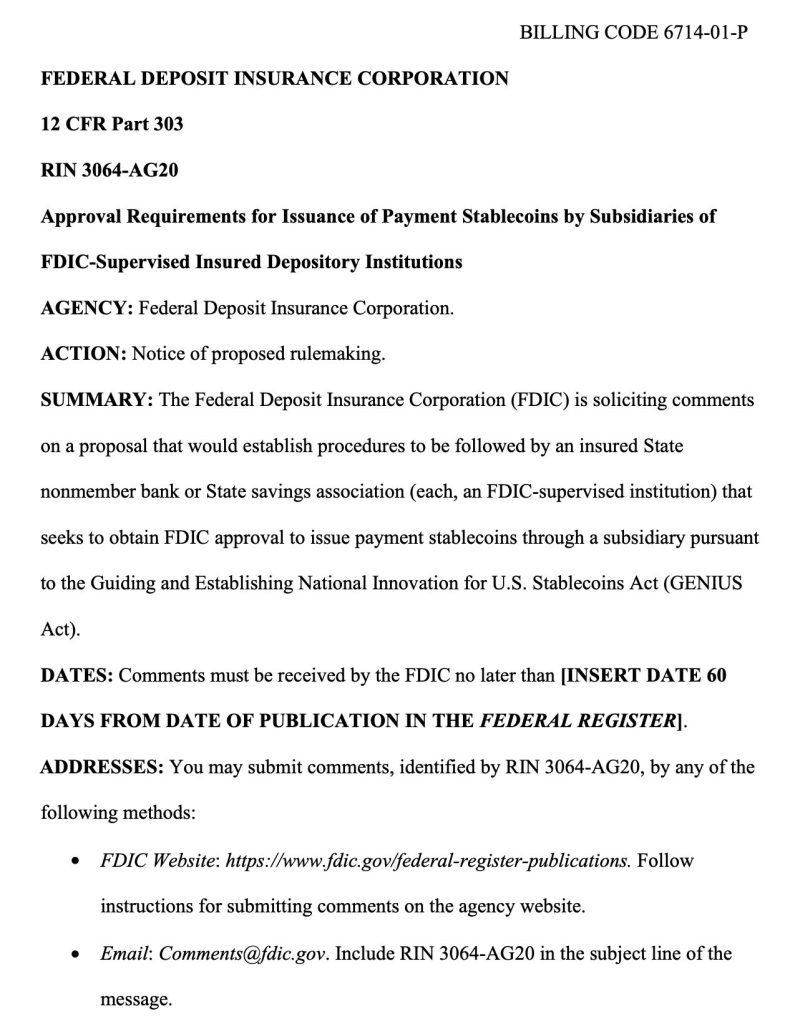
Source: FDIC

The proposed rule, approved unanimously by the FDIC board on Tuesday, would create a formal application process allowing certain state-chartered banks to issue payment stablecoins through separately capitalized subsidiaries.

The framework applies to state nonmember banks and state savings associations supervised by the FDIC.

These banks would not be permitted to issue stablecoins directly on their balance sheets but could do so through a subsidiary that receives prior approval from the agency.

Under the GENIUS Act, only approved entities known as Permitted Payment Stablecoin Issuers are allowed to issue payment stablecoins in the United States.

A payment stablecoin is defined as a digital asset intended for payments or settlement that maintains a stable value, typically backed one-to-one by cash or highly liquid assets such as U.S. Treasury securities.

The law explicitly states that these stablecoins are not deposits, legal tender, or securities.

Here is the FDIC’s Blueprint for Bank-Issued Tokens

The FDIC’s proposal lays out a detailed application process. Banks would be required to submit written requests explaining the structure of the subsidiary, the design of the stablecoin, and how it would maintain price stability.

Applicants must disclose reserve composition, liquidity arrangements, capital levels, governance structures, redemption policies, and reliance on third-party service providers.

The agency also requires information on ownership, management, and control, and bars approval if key personnel have histories of serious financial crimes.

Reserve requirements form a central pillar of the proposal. Stablecoins issued by approved subsidiaries must be fully backed on a one-to-one basis, with clear policies governing reserve management and asset segregation.

Subsidiaries would also need to explain how users can redeem stablecoins for dollars in a timely and transparent manner, including fee disclosures and advance notice of any changes.

To reinforce oversight, each issuer must retain an independent public accounting firm to verify reserve balances through monthly attestations.

What Happens If Regulators Don’t Act? FDIC’s Stablecoin Timer Explained

The timeline outlined in the rule sharply limits regulatory delay.

The FDIC has 30 days to determine whether an application is substantially complete and 120 days to approve or deny it. If the agency fails to act within that period, the application would be deemed approved by operation of law.

Denials must be justified on safety and soundness grounds, and applicants would have access to a dedicated appeals and hearing process.

Notably, the proposal also includes a temporary safe harbor that allows early applicants to request limited waivers of certain GENIUS Act requirements for up to 12 months.

The FDIC will accept public comments on the proposal for 60 days after it is published in the Federal Register.

The move comes amid a broader recalibration of U.S. crypto and digital-asset policy.

Last week, the Office of the Comptroller of the Currency confirmed that national banks may engage in riskless principal crypto transactions, allowing them to intermediate client trades without holding inventory.

Also, the Treasury Department has also begun implementing its responsibilities under the GENIUS Act, including oversight of non-bank stablecoin issuers.

Market Opportunity
Union Logo
Union Price(U)
$0.003345
$0.003345$0.003345
-1.24%
USD
Union (U) Live Price Chart
Disclaimer: The articles reposted on this site are sourced from public platforms and are provided for informational purposes only. They do not necessarily reflect the views of MEXC. All rights remain with the original authors. If you believe any content infringes on third-party rights, please contact service@support.mexc.com for removal. MEXC makes no guarantees regarding the accuracy, completeness, or timeliness of the content and is not responsible for any actions taken based on the information provided. The content does not constitute financial, legal, or other professional advice, nor should it be considered a recommendation or endorsement by MEXC.

You May Also Like

Woodway Assurance receives $1 million in funding for data privacy assurance solution EviData

Woodway Assurance receives $1 million in funding for data privacy assurance solution EviData

OTTAWA, ON, Dec. 17, 2025 /PRNewswire/ – New Canadian technology company Woodway Assurance is proud to announce that it has closed an oversubscribed seed funding
Share
AI Journal2025/12/17 23:16
Wormhole Unleashes W 2.0 Tokenomics for a Connected Blockchain Future

Wormhole Unleashes W 2.0 Tokenomics for a Connected Blockchain Future

TLDR Wormhole reinvents W Tokenomics with Reserve, yield, and unlock upgrades. W Tokenomics: 4% yield, bi-weekly unlocks, and a sustainable Reserve Wormhole shifts to long-term value with treasury, yield, and smoother unlocks. Stakers earn 4% base yield as Wormhole optimizes unlocks for stability. Wormhole’s new Tokenomics align growth, yield, and stability for W holders. Wormhole [...] The post Wormhole Unleashes W 2.0 Tokenomics for a Connected Blockchain Future appeared first on CoinCentral.
Share
Coincentral2025/09/18 02:07
BlackRock boosts AI and US equity exposure in $185 billion models

BlackRock boosts AI and US equity exposure in $185 billion models

The post BlackRock boosts AI and US equity exposure in $185 billion models appeared on BitcoinEthereumNews.com. BlackRock is steering $185 billion worth of model portfolios deeper into US stocks and artificial intelligence. The decision came this week as the asset manager adjusted its entire model suite, increasing its equity allocation and dumping exposure to international developed markets. The firm now sits 2% overweight on stocks, after money moved between several of its biggest exchange-traded funds. This wasn’t a slow shuffle. Billions flowed across multiple ETFs on Tuesday as BlackRock executed the realignment. The iShares S&P 100 ETF (OEF) alone brought in $3.4 billion, the largest single-day haul in its history. The iShares Core S&P 500 ETF (IVV) collected $2.3 billion, while the iShares US Equity Factor Rotation Active ETF (DYNF) added nearly $2 billion. The rebalancing triggered swift inflows and outflows that realigned investor exposure on the back of performance data and macroeconomic outlooks. BlackRock raises equities on strong US earnings The model updates come as BlackRock backs the rally in American stocks, fueled by strong earnings and optimism around rate cuts. In an investment letter obtained by Bloomberg, the firm said US companies have delivered 11% earnings growth since the third quarter of 2024. Meanwhile, earnings across other developed markets barely touched 2%. That gap helped push the decision to drop international holdings in favor of American ones. Michael Gates, lead portfolio manager for BlackRock’s Target Allocation ETF model portfolio suite, said the US market is the only one showing consistency in sales growth, profit delivery, and revisions in analyst forecasts. “The US equity market continues to stand alone in terms of earnings delivery, sales growth and sustainable trends in analyst estimates and revisions,” Michael wrote. He added that non-US developed markets lagged far behind, especially when it came to sales. This week’s changes reflect that position. The move was made ahead of the Federal…
Share
BitcoinEthereumNews2025/09/18 01:44
