Market intelligence platform Glassnode has buttressed the importance of the $2 psychological price mark to XRP investors. XRP recovered to close above $2 last week after a push below. The fourth-largest cryptocurrency by market cap dropped to a low of $1.82 in the previous week, but ETF momentum and a broader market recovery saw it […]Market intelligence platform Glassnode has buttressed the importance of the $2 psychological price mark to XRP investors. XRP recovered to close above $2 last week after a push below. The fourth-largest cryptocurrency by market cap dropped to a low of $1.82 in the previous week, but ETF momentum and a broader market recovery saw it […]

Glassnode Explains Why $2 Is a Critical Zone for XRP

Market intelligence platform Glassnode has buttressed the importance of the $2 psychological price mark to XRP investors.

XRP recovered to close above $2 last week after a push below. The fourth-largest cryptocurrency by market cap dropped to a low of $1.82 in the previous week, but ETF momentum and a broader market recovery saw it bounce to close at $2.04.

This momentum has spilled into the new week, spurring a near 7% increase. Notably, XRP reached an intra-week high of $2.28 before relinquishing some of its upside today.

The $2 Mark Is Crucial for XRP

Meanwhile, XRP is still trading above the $2 zone at the time of writing, an area Glassnode believes is essential to XRP investors’ psychology. The platform identified how holders have reacted to XRP reaching the price mark since early 2025.

For context, the November 24 report shows that investors have realized losses of between $500 million and $1.28 billion per week each time XRP drops to the psychological level since March. An accompanying chart shows that when XRP fell to $1.90 in early March, holders realized losses slightly above $1.2 billion per week.
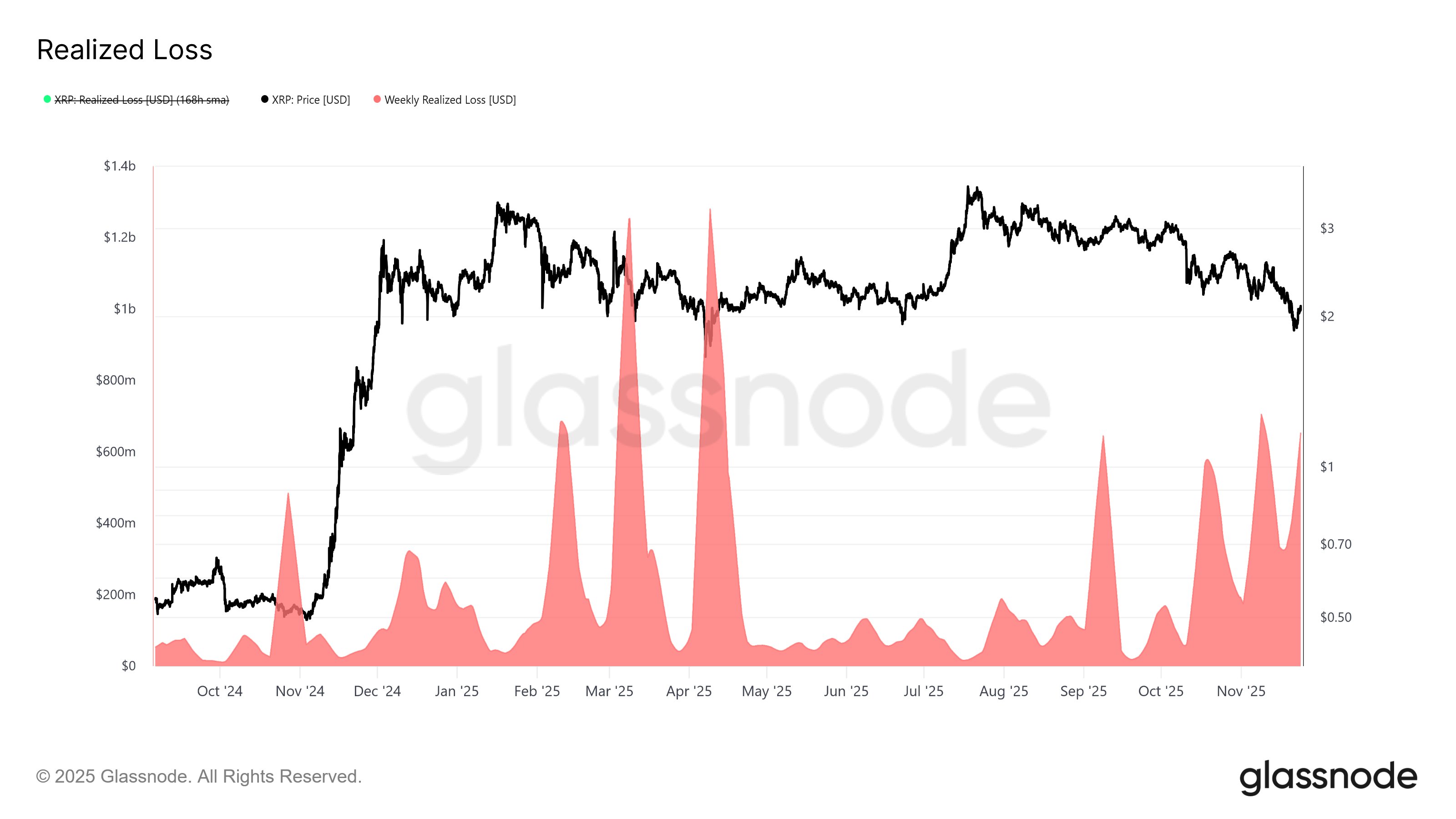
XRP Realized Losses/GlassnodeXRP Realized Losses/Glassnode

A similar scenario happened during the April drop to $1.61. Investors also sold their holdings at a combined loss of nearly $1.3 billion per week. Glassnode highlighted that this emphasizes how investors behave towards the $2 price level. Specifically, a drop below raises skepticism, resulting in the sales even at a loss, while holders remain optimistic above the zone.

Notably, this builds on an earlier report showing that XRP’s daily realized losses have spiked to $75 million daily, the highest level since April. They increased their selling spree from $50 million per day in early October.

Whales Take Profit Amid 17% Rally

In a parallel social media post, analyst Ali Martinez noted that whales are taking profit amid the price rebound. Notably, XRP has rallied over 17% in the last 72 hours, outperforming most major cryptocurrencies.

While it showed signs of recovery, whales holding between 1 million and 10 million XRP locked in profits, selling over 180 million tokens in the process. Further analysis shows that the selloff campaign brought these whales’ new stash to 4.74 billion XRP.

Despite these, XRP seems to be standing strong. The token remains well above $2, specifically changing hands at $2.20, spurred by the ETF buzz. For perspective, the Franklin Templeton and Grayscale XRP ETFs launched yesterday in the US market and had an immediate impact.

They attracted a combined $130 million in positive flow, bringing the net inflow into US XRP ETFs on Monday to $164 million. This institutional lure has absorbed selling pressure, fostering its over 7% 24-hour growth.

Market Opportunity
WHY Logo
WHY Price(WHY)
$0.00000001529
$0.00000001529$0.00000001529
0.00%
USD
WHY (WHY) Live Price Chart
Disclaimer: The articles reposted on this site are sourced from public platforms and are provided for informational purposes only. They do not necessarily reflect the views of MEXC. All rights remain with the original authors. If you believe any content infringes on third-party rights, please contact service@support.mexc.com for removal. MEXC makes no guarantees regarding the accuracy, completeness, or timeliness of the content and is not responsible for any actions taken based on the information provided. The content does not constitute financial, legal, or other professional advice, nor should it be considered a recommendation or endorsement by MEXC.

You May Also Like

The Channel Factories We’ve Been Waiting For

The Channel Factories We’ve Been Waiting For

The post The Channel Factories We’ve Been Waiting For appeared on BitcoinEthereumNews.com. Visions of future technology are often prescient about the broad strokes while flubbing the details. The tablets in “2001: A Space Odyssey” do indeed look like iPads, but you never see the astronauts paying for subscriptions or wasting hours on Candy Crush.  Channel factories are one vision that arose early in the history of the Lightning Network to address some challenges that Lightning has faced from the beginning. Despite having grown to become Bitcoin’s most successful layer-2 scaling solution, with instant and low-fee payments, Lightning’s scale is limited by its reliance on payment channels. Although Lightning shifts most transactions off-chain, each payment channel still requires an on-chain transaction to open and (usually) another to close. As adoption grows, pressure on the blockchain grows with it. The need for a more scalable approach to managing channels is clear. Channel factories were supposed to meet this need, but where are they? In 2025, subnetworks are emerging that revive the impetus of channel factories with some new details that vastly increase their potential. They are natively interoperable with Lightning and achieve greater scale by allowing a group of participants to open a shared multisig UTXO and create multiple bilateral channels, which reduces the number of on-chain transactions and improves capital efficiency. Achieving greater scale by reducing complexity, Ark and Spark perform the same function as traditional channel factories with new designs and additional capabilities based on shared UTXOs.  Channel Factories 101 Channel factories have been around since the inception of Lightning. A factory is a multiparty contract where multiple users (not just two, as in a Dryja-Poon channel) cooperatively lock funds in a single multisig UTXO. They can open, close and update channels off-chain without updating the blockchain for each operation. Only when participants leave or the factory dissolves is an on-chain transaction…
Share
BitcoinEthereumNews2025/09/18 00:09
Why Is the Bitcoin Price Constantly Falling? Analysis Firm Says “The Selling Process Has Reached Saturation,” Shares Its Expectations

Why Is the Bitcoin Price Constantly Falling? Analysis Firm Says “The Selling Process Has Reached Saturation,” Shares Its Expectations

Cryptocurrency analytics company K33 Research has evaluated the recent price movements of Bitcoin. Here are the details. Continue Reading: Why Is the Bitcoin Price
Share
Coinstats2025/12/18 03:53
Gold continues to hit new highs. How to invest in gold in the crypto market?

Gold continues to hit new highs. How to invest in gold in the crypto market?

As Bitcoin encounters a "value winter", real-world gold is recasting the iron curtain of value on the blockchain.
Share
PANews2025/04/14 17:12