

SEC Ends Tokenized Stocks Innovation Exemption, Affects Compliance
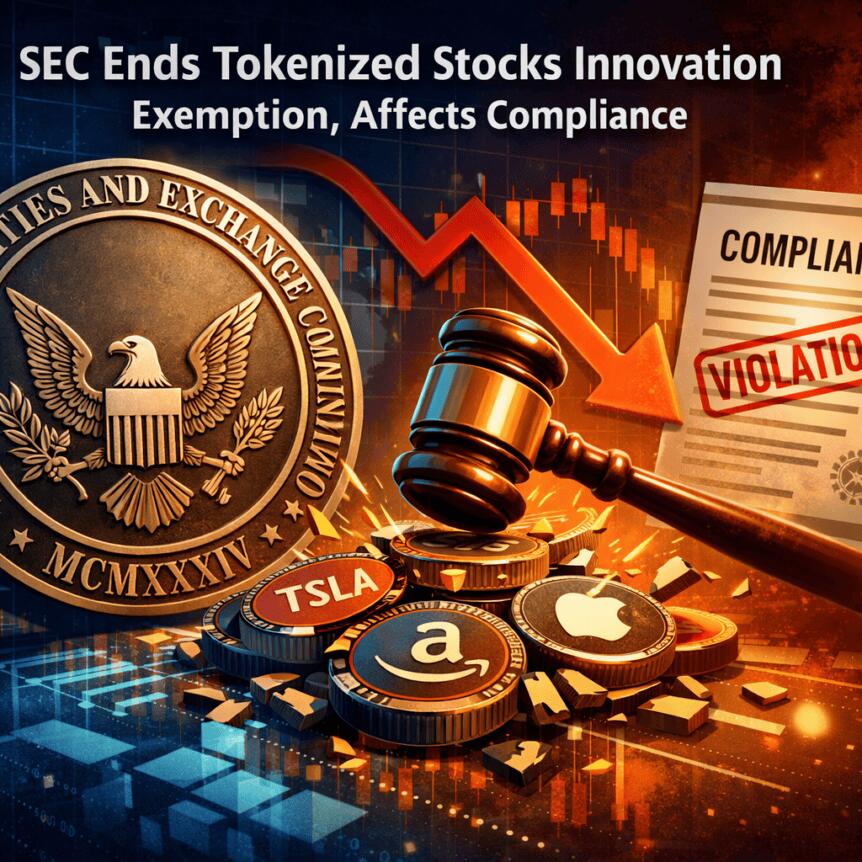
The U.S. Securities and Exchange Commission has effectively postponed its plan to permit trading of tokenized stocks after stock exchange officials signaled potential implementation hurdles. Bloomberg reported on Friday, citing sources familiar with the matter, that the SEC’s crafted “innovation exemption” for crypto-based stock representations was expected to be released within the week, following staff review of a draft proposal.
While the commission has solicited input from hundreds of market participants, it has not announced a decision to alter the proposal. Under the plan, platforms offering tokenized stocks would be required to guarantee investors the same shareholder rights as traditional stock, including dividends and voting rights.
Market participants raised concerns about unauthorized third parties issuing tokens without corporate consent and questions about how ownership would be verified on semi-pseudonymous blockchains, according to Bloomberg’s reporting. The SEC has shown a willingness to explore crypto-powered financial products, a stance that aligns with renewed Wall Street interest in tokenization and stablecoins, a shift noted as occurring under the prior administration.
Data from RWA.xyz illustrates the broader tokenization landscape, showing roughly $34 billion in real-world assets tokenized to date, including about $1.55 billion in tokenized equities. While this signals significant activity, adoption has lagged earlier optimistic projections from institutions such as Citibank and McKinsey, which forecast a multi-trillion-dollar market by 2030.
Key takeaways
- The SEC paused its plan to implement an “innovation exemption” for tokenized stocks amid implementation concerns, with no decision announced to revise the proposal.
- Any tokenized stock market would need to preserve full shareholder rights, including dividends and voting, for holders of crypto-based representations.
- Industry participants highlighted risks around unauthorized token issuances and ownership verification on on-chain ledgers that are not fully transparent or permissioned.
- Tokenization activity has grown to tens of billions in real-world assets, yet the trajectory remains uncertain relative to earlier multi-trillion-dollar projections.
- Regulatory distinctions between custodial and synthetic tokenized securities continue to shape ongoing legal interpretation and enforcement considerations.
Regulatory status and practical implications
The reported delay centers on the SEC’s proposed exemption framework for crypto-based equity representations, often described as an innovation exemption intended to unlock tokenized stock trading while preserving core investor protections. The agency’s plan envisions exchanges and other platforms delivering tokenized versions of U.S. equities that carry the same rights as conventional shares. However, the concerns voiced by market participants focus on two practical hurdles: first, ensuring that token issuance occurs only with the consent of the underlying issuers, and second, establishing reliable mechanisms to prove ownership on blockchains that are semi-pseudonymous and may involve multiple intermediaries.
While the SEC has engaged with hundreds of market participants, the plan is not yet finalized, and officials have indicated continued consideration of stakeholder feedback. The sequence suggests a cautious pace for policy rollout in a space where legal clarity—covering rights, custody, and governance—remains essential for institutional adoption and regulatory compliance programs across banks, trading venues, and asset managers.
From a compliance perspective, the delay highlights the need for robust KYC/AML frameworks, transparent tokenization governance, and clear delineation of when a token qualifies as a claim on an asset versus a price exposure instrument. As regulatory bodies in the United States and overseas scrutinize tokenized securities, firms must align product design with potential enforcement expectations, licensing regimes, and cross-border comparability with frameworks such as MiCA and existing U.S. securities laws administered by the SEC, CFTC, and DOJ.
Industry response and governance challenges
Industry executives have generally supported the SEC’s decision to postpone the exemption to allow a more deliberate approach. Carlos Domingo, CEO of Securitize, underscored the importance of ensuring the exemption targets the right instruments, emphasizing that “Better delay it than get it wrong and unleash all sort of problems.” The sentiment reflects a broader preference for rigor in tokenization governance, particularly around issuer consent, ongoing rights administration, and regulatory oversight.
Tom Farley, the chief executive of Bullish, echoed the theme on social media, noting that the delay reflects a realization that public companies remain the sole issuers of stock that can be tokenized into a share. He framed the postponement as a prudent step toward getting the framework right rather than rushing an implementation that could raise downstream legal and operational risks.
Meanwhile, SEC Commissioner Hester Peirce signaled that any exemption would likely be narrow in scope, supporting digital representations that mirror existing equity securities in the secondary market rather than broad, unrestricted use of tokenized stock across asset classes. Her remarks, reported by Cointelegraph, suggest a regulatory preference for incremental, tightly defined use-cases that minimize potential misalignment with existing securities laws.
These developments come amid a January framework that distinguishes tokenized securities into two principal forms: custodial tokens and synthetic tokens. Custodial tokenized securities are issuer-sponsored and held by regulated intermediaries, with full shareholder rights conferred to token holders. Synthetic tokenized securities, by contrast, provide exposure to price movements without conveying actual ownership in the underlying shares. The distinction matters for enforcement, custody arrangements, and the scope of investor protections applicable to each form.
The broader market context includes ongoing interest from the crypto industry in tokenization and related products, even as adoption remains uneven. Industry observers note that the regulatory trajectory will influence the pace at which tokenized securities can integrate with traditional financial infrastructure, including custody banks, settlement systems, and clearing networks. The evolution of these rules will shape how tokenized assets are valued, regulated, and integrated into institutional portfolios and risk-management frameworks.
Tokenization landscape and enforcement considerations
The tokenization movement has produced a substantial tally of real-world assets represented on blockchain or tokenized formats, underscoring the potential for more efficient settlement, fractional ownership, and broader access to asset classes. Yet the path to sustained, large-scale adoption remains uncertain, constrained by policy clarity, operational risk, and the need for interoperable standards across platforms and jurisdictions. The regulatory environment—ranging from U.S. securities laws to international frameworks—will continue to define permissible structures, disclosure requirements, and oversight mechanisms that govern who can issue tokens, how they are distributed, and how investors’ rights are protected.
As policy makers weigh the best path forward, observers will watch for the SEC’s next steps on the innovation exemption, any accompanying guidance on custodial and synthetic tokenized securities, and how cross-border regulators align on licensing, AML/KYC controls, and upstream risk management. The balance between encouraging innovation and preserving investor protections will remain a central point of emphasis for exchanges, banks, and market participants seeking to participate in a tokenized-era ecosystem.
Source data and narrative developments in this space are evolving. For context, data from RWA.xyz indicates substantial tokenization activity to date, with $34 billion in tokenized real-world assets and $1.55 billion specifically in tokenized equities, illustrating both momentum and the gap between current volumes and early projections of a multi-trillion-dollar market by 2030.
The policy path remains uncertain, but the emphasis on precise instrument definitions, issuer authorization, and robust custody and verification mechanisms is likely to shape the trajectory of tokenized securities in the near term. Institutions and compliance teams should monitor regulatory milestones, ongoing industry engagement, and enforcement signals that may redefine how tokenized assets integrate with mainstream financial infrastructure.
Closing perspectives suggest a continued focus on risk containment, governance clarity, and the need for a framework that can support legitimate tokenization while avoiding unintended consequences. Watch for further updates as the SEC weighs next steps and market participants prepare for potential future rules that could redefine the boundaries of tokenized equity trading.
This article was originally published as SEC Ends Tokenized Stocks Innovation Exemption, Affects Compliance on Crypto Breaking News – your trusted source for crypto news, Bitcoin news, and blockchain updates.


You May Also Like

Next Block Expo 2026 in Warsaw Brings Institutional Focus to Crypto

Crypto selloff deepens with $400 million liquidations and rising short interest

Franklin Templeton CEO Dismisses 50bps Rate Cut Ahead FOMC



