I've been really busy lately and can't write a 10,000-word research report any more. I'll try to change my writing style and just state my opinions and reasoning. Please forgive me, dear readers. 1. Research Background I have recently researched almost all the Perps (perpetual trading platforms) on the market. The five-fold growth of the hype market proves once again that when I first researched it last year, I still overlooked its core value. Moreover, recently aster, antex, dydxV4, and even Sun Ge's sunPerps, which shook the track, have gradually brought the Perps track into a period of explosive growth. Furthermore, major exchanges are vying to list Hyper and its perpetual trading capabilities. Yesterday, news broke that Metamask, following Phantom, is planning to integrate Hyper's perpetual trading capabilities. Circle has also become a validator, addressing concerns about its core decentralization. Hyperliquid itself is also striving to improve its openness, particularly with the gradual rollout of HyperEVM and HIP2/3/4. 1.1 Three Elements of the New Track At this point, Perps basically has the three key elements of a new track. In fact, if we look back at any huge track wave in history, we can see that it is often the new leading platform, new wealth opportunities, and new narrative background. The trend gathering will bring about peaks, while the subsequent platform's airdrop strategy, the gradual development of platform complexity, and the decline in user perception of freshness will gradually bring about troughs. This process has actually gone through many waves. The typical scenarios are as follows. The following modules have been analyzed in the previous public account articles of "Fourteen Gentlemen". If you are interested, you can check it out yourself: The ICO craze of 2017 was centered on the CEX platform. It's a basic necessity, uncontroversial, and many are doing very well now. In the summer of DeFi in 2021, the corresponding platforms are Uniswap, lending and stablecoins, as above. NFTs, which have been around for 22 years, actually have protocols that existed long before, but only reached their peak thanks to OpenSea. The root of this was pricing through transactions, which then led to dissemination based on price. Its decline stemmed from arrogance, with its airdrop strategy and royalties leading to a death spiral of price increases, a self-inflicted consequence. The 23-year-old inscription, corresponding to the platform Unisat, was ultimately driven by short-sightedness. At its peak, it focused on asset issuance, not application development, resulting in a short lifespan for its narrative. When other new narratives emerged, RWA and perps dominated attention, hindering the recent Alkanes and BRC2.0 from regaining their popularity. This is a self-inflicted failure. The 24-year meme and the corresponding pump platform, as well as this year's dark horse Axiom, have made this wave exceptionally long-lasting. This is due to the advantages of the chain itself in terms of transactions, the constant influx of people who are interested in trading, and the new users brought by the wave of compliance, which has enhanced the life cycle. Finally, in 25 years, there are both RWA (focused on stocks) and Perps (led by hyperliquid). 2. Understanding the key steps in the development of hyperliquid 2.1 Current Development Status Objectively speaking, the system remains relatively centralized, theoretically capable of being disrupted by unplugging the network. Furthermore, hacker funds are siphoned off, creating significant obstacles for many exchanges in terms of compliance and attracting significant attention. However, the data is highly contradictory. Hyperliquid currently has about 10,000 to 20,000 daily active users, out of a total user base of about 600,000. A core group of 20,000 to 30,000 of these users contributes nearly $1 billion in revenue, a significant portion of which comes from the United States. The cumulative trading volume has exceeded 3 trillion US dollars, and the average daily trading volume has reached nearly 7 billion US dollars. Currently supports Perps trading of more than 100 assets. Looking at his data in this way, I can only say that it is really great. Although the number of users seems small, they are the group that can make the most money. 2.2 Major Updates and Interpretations The specific timeline is as follows March 25: HyperCore and HyperEVM were connected, theoretically allowing users to trade core tokens from the EVM (trading only at the time). April 30: Launched the read precompile feature, enabling HyperEVM smart contracts to read state from HyperCore. May 26: Small block time halved to 1 second, increasing the throughput of HyperEVM. June 26: The HyperEVM block was updated to remove the previous ordering of only published orders to improve integration with HyperCore. On July 5, HyperEVM updated a new precompiler called CoreWriter. This enables HyperEVM contracts to be written directly into HyperCore, including functions such as placing orders, transferring spot assets, managing treasury bonds, and staking HYPE. Recently, Builder core and Hip4 have also entered the data prediction market. This step of entry was completely unexpected by the market. This also means that the founders have very unique ideas in thinking about the pain points of the industry, which often leads to polarization of the platform. How do you understand this series of updates? First, compared to last year, Hyperliquid now has open core order operation capabilities. HyperEVM In particular, the dual-chain architecture based on EVM has an outrageous logic. Under the premise that HyperCore is not open (cannot be deployed), a large number of pre-compiled contracts are added through HyperEVM and connected to HyperCore. In theory, it has the access basis of wallets (phantom, metamask) and exchanges, and can theoretically realize EVM transaction operations to execute Core's order asset trading and other capabilities. The official picture shows the positioning of hyperEVM in the system It can be seen that HyperCore and HyperEVM writes and reads are uniformly confirmed by HyperBFT. The specific mechanism of the validator's confirmation information mechanism is not public, and there is no cross-chain bridge or delayed synchronization. The dynamics that can be seen through on-chain transactions are that HyperEVM can affect HyperCore by executing writes through the system contract (0x333…3333, CoreWriter.sendAction(...)), which can perform order placement, liquidation, and lending operations. The status (of the previous block) fed back by HyperCore can be read by the smart contract of HyperEVM. User data — positions, balances, and vault information Market Data — Mark Price and Oracle Price Staking data — delegation and validator information System data - L1 block count and other core metrics The information is essentially received by the EVM system contract, which generates corresponding receipts or events and records them. And in the EVM, the precompiled contract (0x000…0800) can call perp positions or oracle price (oraclePx) Secondly, the implementation of hip2 and hip3 is changing the platform positioning of Hyperliquid. Hyperliquidity This is an on-chain liquidity mechanism built into Hypercore. It automatically places buy and sell orders based on the current price of the token, maintaining a narrow spread of approximately 0.3% without manual intervention. This mechanism allows for native-level liquidity insertion operations built into the block logic without AMMs or third-party bots. For example, when the PURR/USDC spot market launched, Hyperliquidity immediately issued seed transactions with initial depth, allowing real trading before normal user liquidity arrived. Builder core This mechanism is highly valuable for the future, allowing DeFi builders (developers, quantitative teams, and aggregators) to collect additional fees as service revenue when placing orders on behalf of users. The application scenario for this system is clear, and it represents a move to open up profits and embrace ecosystem co-construction. **Quantitative strategy hosting, **The quantitative team helps users place perp position orders and collects management fees through builder fees, forming a compound profit model of "revenue sharing + builder fee" **Aggregators/transaction routers,** such as 1inch and Odyssey, integrate perp trading services on Hyperliquid and can charge builder fees as a routing revenue model. The initial launch has already brought over 10 million US dollars in dividend income to some projects, which shows the effect of hyper funds being deeply deposited at the platform level. In fact, the issue of opening up depth is not just Hyper. The previous Uniswapv4 also wanted to do this through hooks, but v4 did not take off, and most users are still accustomed to v2 and v3. This may be the influence of having less historical baggage and stronger centralized decision-making. 3 Summary and Comments 3.1 There are many advantages. Let’s go through them one by one. Hyperliquid's primary advantage was its strong early product capabilities, which stemmed from addressing two user pain points: The trading needs of non-compliant users are actually even more rare in this year's wave of compliance. Advanced trading users demand high leverage and high transparency. The former brings KOL exposure, while the latter is often ignored by market incumbents, that is, the dark under the light, thus catching many CEXs off guard. The second is the team background itself. Its biggest advantage here is that it has a small number of people, so the communication gap, wear and tear, and labor efficiency are all very high. With an overall staff of more than a dozen people, excluding 3-4 product operation BDs and deducting the front-end and back-end, it means that only 3-4 people can build a high-performance chain of 20Wtps. Compared with many blockchain teams of traditional large companies, which can also produce a lot of palace fighting dramas, it is much better. In the background, his market maker foundation started in 2020 actually brought good initial depth. He also felt in many details that his matching logic and other order book systems are not simply settled gradually by time and amount. However, the data is insufficient, so I will supplement it later when I do comparative analysis of multiple Perps. Then there's the trend. General projects need to adapt to the market, but when a platform reaches its peak popularity, the market can adapt to it. This is the treatment Hyperliquid is receiving now. On the one hand, the openness of the aforementioned updates creates space for diverse ecosystems to enter. This contrasts with many previous platforms, which often prioritized doing everything themselves, reaping all the benefits, single-handedly criticizing OpenSea, and even imposing mandatory royalty systems, forcing the market to follow the leading platform. Each of these platforms incurs high, fixed costs, interfering with the flow of goods and affecting market pricing, ultimately becoming a family heirloom. In Hype, he opened up EVM and all kinds of DEX PEPS APIs, so soon a bunch of derivatives appeared on the market. Hyperliquid's generosity can also be seen in the airdrop. It was impossible for it to take the compliance route from the beginning. Therefore, he will not try to embrace the so-called expectations of going public, so he will naturally release the profits. Then he will pledge the hype back through the HLP mechanism, release the profits and make profits again, so that the official tokens can be dispersed and the market will gain the most valuable decentralized evaluation and reputation. Its openness has attracted market acclaim. Phantom first integrated its perps capabilities from the perspective of a decentralized wallet. This is not difficult, mainly due to the large amount of adaptation and development costs. Recently, there are rumors that Metamask is also integrating it. From this we can also see that those decentralized wallets that have not been updated for more than half a year have also learned to seize the annual narrative after missing the inscription. Finally, he pushed for the introduction of giants such as Circle to join as validators to bring decentralized security and fill his decentralization gap, so that highly compliant CEX platforms also had the opportunity to access. 3.2 Disadvantages After the most challenging initial phase, the next issue is compliance. Even pure DEXs like Uniswap are embracing compliance, not to mention the European and American Hyperliquid, whose users have also made their fortunes. If a platform is deemed non-compliant or otherwise severely errs, existing CEX/Wallet partnerships will be severed, and former allies will part ways. In addition, the subsequent development of this system will also face the problem of development complexity. Most projects become more and more complicated as they are written, and it is difficult to simplify them and return to the first principles. In the end, novice users cannot understand how to use them and lose fresh blood. Finally, there's the single-point risk. The current claimed 20Wtps, if accessed by multiple global platforms, would create numerous information inconsistencies, placing immense pressure on the core hyperCore module. Building this high performance takes time. The official market maker background may not be able to handle the volume, and if multiple outages trigger liquidation issues (similar to the short squeeze incident in March), this could lead to significant downtime. The reputation that is accumulated with great difficulty is inherently fragile.I've been really busy lately and can't write a 10,000-word research report any more. I'll try to change my writing style and just state my opinions and reasoning. Please forgive me, dear readers. 1. Research Background I have recently researched almost all the Perps (perpetual trading platforms) on the market. The five-fold growth of the hype market proves once again that when I first researched it last year, I still overlooked its core value. Moreover, recently aster, antex, dydxV4, and even Sun Ge's sunPerps, which shook the track, have gradually brought the Perps track into a period of explosive growth. Furthermore, major exchanges are vying to list Hyper and its perpetual trading capabilities. Yesterday, news broke that Metamask, following Phantom, is planning to integrate Hyper's perpetual trading capabilities. Circle has also become a validator, addressing concerns about its core decentralization. Hyperliquid itself is also striving to improve its openness, particularly with the gradual rollout of HyperEVM and HIP2/3/4. 1.1 Three Elements of the New Track At this point, Perps basically has the three key elements of a new track. In fact, if we look back at any huge track wave in history, we can see that it is often the new leading platform, new wealth opportunities, and new narrative background. The trend gathering will bring about peaks, while the subsequent platform's airdrop strategy, the gradual development of platform complexity, and the decline in user perception of freshness will gradually bring about troughs. This process has actually gone through many waves. The typical scenarios are as follows. The following modules have been analyzed in the previous public account articles of "Fourteen Gentlemen". If you are interested, you can check it out yourself: The ICO craze of 2017 was centered on the CEX platform. It's a basic necessity, uncontroversial, and many are doing very well now. In the summer of DeFi in 2021, the corresponding platforms are Uniswap, lending and stablecoins, as above. NFTs, which have been around for 22 years, actually have protocols that existed long before, but only reached their peak thanks to OpenSea. The root of this was pricing through transactions, which then led to dissemination based on price. Its decline stemmed from arrogance, with its airdrop strategy and royalties leading to a death spiral of price increases, a self-inflicted consequence. The 23-year-old inscription, corresponding to the platform Unisat, was ultimately driven by short-sightedness. At its peak, it focused on asset issuance, not application development, resulting in a short lifespan for its narrative. When other new narratives emerged, RWA and perps dominated attention, hindering the recent Alkanes and BRC2.0 from regaining their popularity. This is a self-inflicted failure. The 24-year meme and the corresponding pump platform, as well as this year's dark horse Axiom, have made this wave exceptionally long-lasting. This is due to the advantages of the chain itself in terms of transactions, the constant influx of people who are interested in trading, and the new users brought by the wave of compliance, which has enhanced the life cycle. Finally, in 25 years, there are both RWA (focused on stocks) and Perps (led by hyperliquid). 2. Understanding the key steps in the development of hyperliquid 2.1 Current Development Status Objectively speaking, the system remains relatively centralized, theoretically capable of being disrupted by unplugging the network. Furthermore, hacker funds are siphoned off, creating significant obstacles for many exchanges in terms of compliance and attracting significant attention. However, the data is highly contradictory. Hyperliquid currently has about 10,000 to 20,000 daily active users, out of a total user base of about 600,000. A core group of 20,000 to 30,000 of these users contributes nearly $1 billion in revenue, a significant portion of which comes from the United States. The cumulative trading volume has exceeded 3 trillion US dollars, and the average daily trading volume has reached nearly 7 billion US dollars. Currently supports Perps trading of more than 100 assets. Looking at his data in this way, I can only say that it is really great. Although the number of users seems small, they are the group that can make the most money. 2.2 Major Updates and Interpretations The specific timeline is as follows March 25: HyperCore and HyperEVM were connected, theoretically allowing users to trade core tokens from the EVM (trading only at the time). April 30: Launched the read precompile feature, enabling HyperEVM smart contracts to read state from HyperCore. May 26: Small block time halved to 1 second, increasing the throughput of HyperEVM. June 26: The HyperEVM block was updated to remove the previous ordering of only published orders to improve integration with HyperCore. On July 5, HyperEVM updated a new precompiler called CoreWriter. This enables HyperEVM contracts to be written directly into HyperCore, including functions such as placing orders, transferring spot assets, managing treasury bonds, and staking HYPE. Recently, Builder core and Hip4 have also entered the data prediction market. This step of entry was completely unexpected by the market. This also means that the founders have very unique ideas in thinking about the pain points of the industry, which often leads to polarization of the platform. How do you understand this series of updates? First, compared to last year, Hyperliquid now has open core order operation capabilities. HyperEVM In particular, the dual-chain architecture based on EVM has an outrageous logic. Under the premise that HyperCore is not open (cannot be deployed), a large number of pre-compiled contracts are added through HyperEVM and connected to HyperCore. In theory, it has the access basis of wallets (phantom, metamask) and exchanges, and can theoretically realize EVM transaction operations to execute Core's order asset trading and other capabilities. The official picture shows the positioning of hyperEVM in the system It can be seen that HyperCore and HyperEVM writes and reads are uniformly confirmed by HyperBFT. The specific mechanism of the validator's confirmation information mechanism is not public, and there is no cross-chain bridge or delayed synchronization. The dynamics that can be seen through on-chain transactions are that HyperEVM can affect HyperCore by executing writes through the system contract (0x333…3333, CoreWriter.sendAction(...)), which can perform order placement, liquidation, and lending operations. The status (of the previous block) fed back by HyperCore can be read by the smart contract of HyperEVM. User data — positions, balances, and vault information Market Data — Mark Price and Oracle Price Staking data — delegation and validator information System data - L1 block count and other core metrics The information is essentially received by the EVM system contract, which generates corresponding receipts or events and records them. And in the EVM, the precompiled contract (0x000…0800) can call perp positions or oracle price (oraclePx) Secondly, the implementation of hip2 and hip3 is changing the platform positioning of Hyperliquid. Hyperliquidity This is an on-chain liquidity mechanism built into Hypercore. It automatically places buy and sell orders based on the current price of the token, maintaining a narrow spread of approximately 0.3% without manual intervention. This mechanism allows for native-level liquidity insertion operations built into the block logic without AMMs or third-party bots. For example, when the PURR/USDC spot market launched, Hyperliquidity immediately issued seed transactions with initial depth, allowing real trading before normal user liquidity arrived. Builder core This mechanism is highly valuable for the future, allowing DeFi builders (developers, quantitative teams, and aggregators) to collect additional fees as service revenue when placing orders on behalf of users. The application scenario for this system is clear, and it represents a move to open up profits and embrace ecosystem co-construction. **Quantitative strategy hosting, **The quantitative team helps users place perp position orders and collects management fees through builder fees, forming a compound profit model of "revenue sharing + builder fee" **Aggregators/transaction routers,** such as 1inch and Odyssey, integrate perp trading services on Hyperliquid and can charge builder fees as a routing revenue model. The initial launch has already brought over 10 million US dollars in dividend income to some projects, which shows the effect of hyper funds being deeply deposited at the platform level. In fact, the issue of opening up depth is not just Hyper. The previous Uniswapv4 also wanted to do this through hooks, but v4 did not take off, and most users are still accustomed to v2 and v3. This may be the influence of having less historical baggage and stronger centralized decision-making. 3 Summary and Comments 3.1 There are many advantages. Let’s go through them one by one. Hyperliquid's primary advantage was its strong early product capabilities, which stemmed from addressing two user pain points: The trading needs of non-compliant users are actually even more rare in this year's wave of compliance. Advanced trading users demand high leverage and high transparency. The former brings KOL exposure, while the latter is often ignored by market incumbents, that is, the dark under the light, thus catching many CEXs off guard. The second is the team background itself. Its biggest advantage here is that it has a small number of people, so the communication gap, wear and tear, and labor efficiency are all very high. With an overall staff of more than a dozen people, excluding 3-4 product operation BDs and deducting the front-end and back-end, it means that only 3-4 people can build a high-performance chain of 20Wtps. Compared with many blockchain teams of traditional large companies, which can also produce a lot of palace fighting dramas, it is much better. In the background, his market maker foundation started in 2020 actually brought good initial depth. He also felt in many details that his matching logic and other order book systems are not simply settled gradually by time and amount. However, the data is insufficient, so I will supplement it later when I do comparative analysis of multiple Perps. Then there's the trend. General projects need to adapt to the market, but when a platform reaches its peak popularity, the market can adapt to it. This is the treatment Hyperliquid is receiving now. On the one hand, the openness of the aforementioned updates creates space for diverse ecosystems to enter. This contrasts with many previous platforms, which often prioritized doing everything themselves, reaping all the benefits, single-handedly criticizing OpenSea, and even imposing mandatory royalty systems, forcing the market to follow the leading platform. Each of these platforms incurs high, fixed costs, interfering with the flow of goods and affecting market pricing, ultimately becoming a family heirloom. In Hype, he opened up EVM and all kinds of DEX PEPS APIs, so soon a bunch of derivatives appeared on the market. Hyperliquid's generosity can also be seen in the airdrop. It was impossible for it to take the compliance route from the beginning. Therefore, he will not try to embrace the so-called expectations of going public, so he will naturally release the profits. Then he will pledge the hype back through the HLP mechanism, release the profits and make profits again, so that the official tokens can be dispersed and the market will gain the most valuable decentralized evaluation and reputation. Its openness has attracted market acclaim. Phantom first integrated its perps capabilities from the perspective of a decentralized wallet. This is not difficult, mainly due to the large amount of adaptation and development costs. Recently, there are rumors that Metamask is also integrating it. From this we can also see that those decentralized wallets that have not been updated for more than half a year have also learned to seize the annual narrative after missing the inscription. Finally, he pushed for the introduction of giants such as Circle to join as validators to bring decentralized security and fill his decentralization gap, so that highly compliant CEX platforms also had the opportunity to access. 3.2 Disadvantages After the most challenging initial phase, the next issue is compliance. Even pure DEXs like Uniswap are embracing compliance, not to mention the European and American Hyperliquid, whose users have also made their fortunes. If a platform is deemed non-compliant or otherwise severely errs, existing CEX/Wallet partnerships will be severed, and former allies will part ways. In addition, the subsequent development of this system will also face the problem of development complexity. Most projects become more and more complicated as they are written, and it is difficult to simplify them and return to the first principles. In the end, novice users cannot understand how to use them and lose fresh blood. Finally, there's the single-point risk. The current claimed 20Wtps, if accessed by multiple global platforms, would create numerous information inconsistencies, placing immense pressure on the core hyperCore module. Building this high performance takes time. The official market maker background may not be able to handle the volume, and if multiple outages trigger liquidation issues (similar to the short squeeze incident in March), this could lead to significant downtime. The reputation that is accumulated with great difficulty is inherently fragile.
Hyperliquid's success and hidden dangers

2025/09/22 13:00
11 min read
For feedback or concerns regarding this content, please contact us at crypto.news@mexc.com

I've been really busy lately and can't write a 10,000-word research report any more. I'll try to change my writing style and just state my opinions and reasoning. Please forgive me, dear readers.

1. Research Background

I have recently researched almost all the Perps (perpetual trading platforms) on the market. The five-fold growth of the hype market proves once again that when I first researched it last year, I still overlooked its core value.

Moreover, recently aster, antex, dydxV4, and even Sun Ge's sunPerps, which shook the track, have gradually brought the Perps track into a period of explosive growth.

Furthermore, major exchanges are vying to list Hyper and its perpetual trading capabilities. Yesterday, news broke that Metamask, following Phantom, is planning to integrate Hyper's perpetual trading capabilities. Circle has also become a validator, addressing concerns about its core decentralization. Hyperliquid itself is also striving to improve its openness, particularly with the gradual rollout of HyperEVM and HIP2/3/4.

1.1 Three Elements of the New Track

At this point, Perps basically has the three key elements of a new track.

In fact, if we look back at any huge track wave in history, we can see that it is often the new leading platform, new wealth opportunities, and new narrative background. The trend gathering will bring about peaks, while the subsequent platform's airdrop strategy, the gradual development of platform complexity, and the decline in user perception of freshness will gradually bring about troughs.

This process has actually gone through many waves. The typical scenarios are as follows. The following modules have been analyzed in the previous public account articles of "Fourteen Gentlemen". If you are interested, you can check it out yourself:

  • The ICO craze of 2017 was centered on the CEX platform. It's a basic necessity, uncontroversial, and many are doing very well now.
  • In the summer of DeFi in 2021, the corresponding platforms are Uniswap, lending and stablecoins, as above.
  • NFTs, which have been around for 22 years, actually have protocols that existed long before, but only reached their peak thanks to OpenSea. The root of this was pricing through transactions, which then led to dissemination based on price. Its decline stemmed from arrogance, with its airdrop strategy and royalties leading to a death spiral of price increases, a self-inflicted consequence.
  • The 23-year-old inscription, corresponding to the platform Unisat, was ultimately driven by short-sightedness. At its peak, it focused on asset issuance, not application development, resulting in a short lifespan for its narrative. When other new narratives emerged, RWA and perps dominated attention, hindering the recent Alkanes and BRC2.0 from regaining their popularity. This is a self-inflicted failure.
  • The 24-year meme and the corresponding pump platform, as well as this year's dark horse Axiom, have made this wave exceptionally long-lasting. This is due to the advantages of the chain itself in terms of transactions, the constant influx of people who are interested in trading, and the new users brought by the wave of compliance, which has enhanced the life cycle.
  • Finally, in 25 years, there are both RWA (focused on stocks) and Perps (led by hyperliquid).

2. Understanding the key steps in the development of hyperliquid

2.1 Current Development Status

Objectively speaking, the system remains relatively centralized, theoretically capable of being disrupted by unplugging the network. Furthermore, hacker funds are siphoned off, creating significant obstacles for many exchanges in terms of compliance and attracting significant attention. However, the data is highly contradictory.

Hyperliquid currently has about 10,000 to 20,000 daily active users, out of a total user base of about 600,000. A core group of 20,000 to 30,000 of these users contributes nearly $1 billion in revenue, a significant portion of which comes from the United States.

The cumulative trading volume has exceeded 3 trillion US dollars, and the average daily trading volume has reached nearly 7 billion US dollars.

Currently supports Perps trading of more than 100 assets.

Looking at his data in this way, I can only say that it is really great. Although the number of users seems small, they are the group that can make the most money.

2.2 Major Updates and Interpretations

The specific timeline is as follows

  • March 25: HyperCore and HyperEVM were connected, theoretically allowing users to trade core tokens from the EVM (trading only at the time).
  • April 30: Launched the read precompile feature, enabling HyperEVM smart contracts to read state from HyperCore.
  • May 26: Small block time halved to 1 second, increasing the throughput of HyperEVM.
  • June 26: The HyperEVM block was updated to remove the previous ordering of only published orders to improve integration with HyperCore.

On July 5, HyperEVM updated a new precompiler called CoreWriter. This enables HyperEVM contracts to be written directly into HyperCore, including functions such as placing orders, transferring spot assets, managing treasury bonds, and staking HYPE.

Recently, Builder core and Hip4 have also entered the data prediction market. This step of entry was completely unexpected by the market. This also means that the founders have very unique ideas in thinking about the pain points of the industry, which often leads to polarization of the platform.

How do you understand this series of updates?

First, compared to last year, Hyperliquid now has open core order operation capabilities.

HyperEVM

In particular, the dual-chain architecture based on EVM has an outrageous logic. Under the premise that HyperCore is not open (cannot be deployed), a large number of pre-compiled contracts are added through HyperEVM and connected to HyperCore. In theory, it has the access basis of wallets (phantom, metamask) and exchanges, and can theoretically realize EVM transaction operations to execute Core's order asset trading and other capabilities.

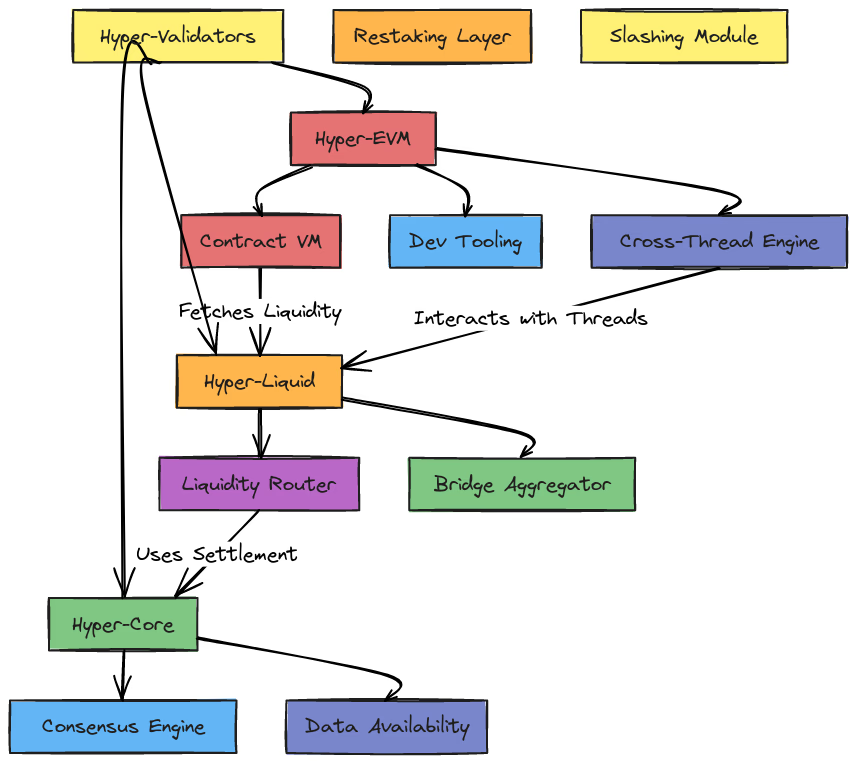
The official picture shows the positioning of hyperEVM in the system

It can be seen that HyperCore and HyperEVM writes and reads are uniformly confirmed by HyperBFT. The specific mechanism of the validator's confirmation information mechanism is not public, and there is no cross-chain bridge or delayed synchronization.

The dynamics that can be seen through on-chain transactions are that HyperEVM can affect HyperCore by executing writes through the system contract (0x333…3333, CoreWriter.sendAction(...)), which can perform order placement, liquidation, and lending operations.

The status (of the previous block) fed back by HyperCore can be read by the smart contract of HyperEVM.

  • User data — positions, balances, and vault information
  • Market Data — Mark Price and Oracle Price
  • Staking data — delegation and validator information
  • System data - L1 block count and other core metrics

The information is essentially received by the EVM system contract, which generates corresponding receipts or events and records them. And in the EVM, the precompiled contract (0x000…0800) can call perp positions or oracle price (oraclePx)

Secondly, the implementation of hip2 and hip3 is changing the platform positioning of Hyperliquid.

Hyperliquidity

This is an on-chain liquidity mechanism built into Hypercore.

It automatically places buy and sell orders based on the current price of the token, maintaining a narrow spread of approximately 0.3% without manual intervention.

This mechanism allows for native-level liquidity insertion operations built into the block logic without AMMs or third-party bots.

For example, when the PURR/USDC spot market launched, Hyperliquidity immediately issued seed transactions with initial depth, allowing real trading before normal user liquidity arrived.

Builder core

This mechanism is highly valuable for the future, allowing DeFi builders (developers, quantitative teams, and aggregators) to collect additional fees as service revenue when placing orders on behalf of users. The application scenario for this system is clear, and it represents a move to open up profits and embrace ecosystem co-construction.

**Quantitative strategy hosting, **The quantitative team helps users place perp position orders and collects management fees through builder fees, forming a compound profit model of "revenue sharing + builder fee"

**Aggregators/transaction routers,** such as 1inch and Odyssey, integrate perp trading services on Hyperliquid and can charge builder fees as a routing revenue model.

The initial launch has already brought over 10 million US dollars in dividend income to some projects, which shows the effect of hyper funds being deeply deposited at the platform level.

In fact, the issue of opening up depth is not just Hyper. The previous Uniswapv4 also wanted to do this through hooks, but v4 did not take off, and most users are still accustomed to v2 and v3.

This may be the influence of having less historical baggage and stronger centralized decision-making.

3 Summary and Comments

3.1 There are many advantages. Let’s go through them one by one.

Hyperliquid's primary advantage was its strong early product capabilities, which stemmed from addressing two user pain points:

  • The trading needs of non-compliant users are actually even more rare in this year's wave of compliance.
  • Advanced trading users demand high leverage and high transparency. The former brings KOL exposure, while the latter is often ignored by market incumbents, that is, the dark under the light, thus catching many CEXs off guard.

The second is the team background itself. Its biggest advantage here is that it has a small number of people, so the communication gap, wear and tear, and labor efficiency are all very high. With an overall staff of more than a dozen people, excluding 3-4 product operation BDs and deducting the front-end and back-end, it means that only 3-4 people can build a high-performance chain of 20Wtps.

Compared with many blockchain teams of traditional large companies, which can also produce a lot of palace fighting dramas, it is much better.

In the background, his market maker foundation started in 2020 actually brought good initial depth. He also felt in many details that his matching logic and other order book systems are not simply settled gradually by time and amount.

However, the data is insufficient, so I will supplement it later when I do comparative analysis of multiple Perps.

Then there's the trend.

General projects need to adapt to the market, but when a platform reaches its peak popularity, the market can adapt to it.

This is the treatment Hyperliquid is receiving now.

On the one hand, the openness of the aforementioned updates creates space for diverse ecosystems to enter. This contrasts with many previous platforms, which often prioritized doing everything themselves, reaping all the benefits, single-handedly criticizing OpenSea, and even imposing mandatory royalty systems, forcing the market to follow the leading platform. Each of these platforms incurs high, fixed costs, interfering with the flow of goods and affecting market pricing, ultimately becoming a family heirloom.

In Hype, he opened up EVM and all kinds of DEX PEPS APIs, so soon a bunch of derivatives appeared on the market.

Hyperliquid's generosity can also be seen in the airdrop. It was impossible for it to take the compliance route from the beginning.

Therefore, he will not try to embrace the so-called expectations of going public, so he will naturally release the profits. Then he will pledge the hype back through the HLP mechanism, release the profits and make profits again, so that the official tokens can be dispersed and the market will gain the most valuable decentralized evaluation and reputation.

Its openness has attracted market acclaim. Phantom first integrated its perps capabilities from the perspective of a decentralized wallet. This is not difficult, mainly due to the large amount of adaptation and development costs. Recently, there are rumors that Metamask is also integrating it.

From this we can also see that those decentralized wallets that have not been updated for more than half a year have also learned to seize the annual narrative after missing the inscription.

Finally, he pushed for the introduction of giants such as Circle to join as validators to bring decentralized security and fill his decentralization gap, so that highly compliant CEX platforms also had the opportunity to access.

3.2 Disadvantages

After the most challenging initial phase, the next issue is compliance. Even pure DEXs like Uniswap are embracing compliance, not to mention the European and American Hyperliquid, whose users have also made their fortunes. If a platform is deemed non-compliant or otherwise severely errs, existing CEX/Wallet partnerships will be severed, and former allies will part ways.

In addition, the subsequent development of this system will also face the problem of development complexity. Most projects become more and more complicated as they are written, and it is difficult to simplify them and return to the first principles. In the end, novice users cannot understand how to use them and lose fresh blood.

Finally, there's the single-point risk. The current claimed 20Wtps, if accessed by multiple global platforms, would create numerous information inconsistencies, placing immense pressure on the core hyperCore module. Building this high performance takes time. The official market maker background may not be able to handle the volume, and if multiple outages trigger liquidation issues (similar to the short squeeze incident in March), this could lead to significant downtime.

The reputation that is accumulated with great difficulty is inherently fragile.

Market Opportunity
Threshold Logo
Threshold Price(T)
$0.006243
$0.006243$0.006243
-4.58%
USD
Threshold (T) Live Price Chart
Disclaimer: The articles reposted on this site are sourced from public platforms and are provided for informational purposes only. They do not necessarily reflect the views of MEXC. All rights remain with the original authors. If you believe any content infringes on third-party rights, please contact crypto.news@mexc.com for removal. MEXC makes no guarantees regarding the accuracy, completeness, or timeliness of the content and is not responsible for any actions taken based on the information provided. The content does not constitute financial, legal, or other professional advice, nor should it be considered a recommendation or endorsement by MEXC.

You May Also Like

The FDA Is Trying To Make Corporate Free Speech Situational

The FDA Is Trying To Make Corporate Free Speech Situational

The post The FDA Is Trying To Make Corporate Free Speech Situational appeared on BitcoinEthereumNews.com. BENSENVILLE, ILLINOIS – SEPTEMBER 10: Flanked by U.S. Attorney General Pam Bondi (rear), and FDA Commissioner Marty Makary (R), Secretary of Health and Human Services Robert F. Kennedy Jr. speaks to the press outside Midwest Distribution after it was raided by federal agents on September 10, 2025 in Bensenville, Illinois. According to the company, various e-liquids were seized in the raid. (Photo by Scott Olson/Getty Images) Getty Images While running for President in 2008, Barack Obama famously chanted “Yes we can.” Love or hate his political views, Obama’s politics were quite effective. He was asking voters to think big, to envision a much better future. Advertisers no doubt approved. That’s because ads routinely evoke things not as they are, but as they could be. Gyms and exercise equipment companies don’t promote their locations and equipment with flabby, lumbering people, rather their ads show fit, upright, energetic individuals. A look ahead. Restaurants do the same with ads showing happy people enjoying impressively put together plates of food. Conversely, ads meant to convince smokers to quit have not infrequently shown the worst of the worst future downsides of the habit. The nature of advertising comes to mind as FDA commissioner Marty Makary puzzlingly brags that “The Trump Administration Is Taking On Big Pharma” in the New York Times. Makary laments pharmaceutical ads that “are filled with dancing patients, glowing smiles and catch jingles that drown out the fine print.” Not explained is whether Makary would be happier if drug companies placed ads with immobile patients, frowns, and funereal music. Seriously, what does he expect? Does he want drug companies to commit billions to drug development to accompany their achievements with imagery defined by misery? Has Makary stopped to contemplate the myriad shareholders lawsuits drugmakers would face if, upon risking staggering sums meant…
Share
BitcoinEthereumNews2025/09/18 06:29
Bitcoin’s cycle clock points to a final high by late October, will ETFs rewrite history?

Bitcoin’s cycle clock points to a final high by late October, will ETFs rewrite history?

The post Bitcoin’s cycle clock points to a final high by late October, will ETFs rewrite history? appeared on BitcoinEthereumNews.com. Bitcoin price trades near $117,000 after the Federal Reserve decision on interest rates, as the 1,065-day post-halving window approaches. The Fed cut rates by 25bps yesterday, placing Bitcoin’s near-term path at the intersection of policy and a cycle marker Axios says has historically captured a “final high” roughly 1,065 days after a prior cycle low. The test window runs through late September and early October, then the market will trade into Thanksgiving on flow, dollar, and rate dynamics that can either extend the advance or start the topping process that prior cycles paired with drawdowns of 40 to 60 percent, according to Axios. Spot ETF demand is the first lever to watch because it turns the cycle into a flow problem. According to CoinShares’ latest weekly fund-flow update, U.S. spot Bitcoin ETFs saw renewed net inflows in late August and early September, measured in billions of dollars, while SoSoValue tracked a mid-September multi-session inflow streak with a single-day print of around $260 million on September 15. Those figures contrast with the post-halving issuance of about 452 Bitcoin per day, calculated as 3.125 Bitcoin per block times roughly 144 blocks per day. When multi-day ETF demand absorbs several thousand Bitcoin per week, the market’s ability to distribute inventory at the highs narrows, and topping processes can lengthen into a plateau rather than a single peak. Macro conditions set the second lever. This month, the euro touched a four-year high against the dollar as cut expectations increased, while front-end Treasury yields eased into the meeting. A softer dollar lowers global financial conditions and often correlates with higher beta across risk assets. At the same time, domestic inflation has cooled from last year’s pace, with August headline CPI at 2.5 percent year over year and core at 3.0 percent, according to the Bureau of Labor…

Share
BitcoinEthereumNews2025/09/18 20:10
Huawei reveals giant new AI chip cluster as Nvidia’s China issues rise

Huawei reveals giant new AI chip cluster as Nvidia’s China issues rise

The post Huawei reveals giant new AI chip cluster as Nvidia’s China issues rise appeared on BitcoinEthereumNews.com. A person walks past a display of an Atlas 900 AI cluster at the Huawei stand during the World Artificial Intelligence Conference at the Shanghai World Expo and Convention Center in Shanghai on July 28, 2025. Hector Retamal | Afp | Getty Images BEIJING — Chinese telecommunications giant Huawei announced Thursday new computing systems for powering artificial intelligence with its in-house Ascend chips, as it steps up pressure on U.S. rival Nvidia. The company said it plans to launch its new “Atlas 950 SuperCluster” as soon as next year. The U.S. has sought to cut China off from the most advanced semiconductors for training AI models. To cope, Chinese companies have turned more to grouping large numbers of less efficient, often homegrown, chips together to achieve similar computing capabilities. Under Huawei’s AI computing infrastructure, a supercluster is connected to multiple superpods, which, in turn, are built from multiple supernodes. Supernodes, which form the base, are built on Ascend chips, using system design to overcome technical limitations imposed by U.S. sanctions. Huawei said its new Atlas 950 supernode would support 8,192 Ascend chips, and that the Atlas 950 SuperCluster would use more than 500,000 chips. A more advanced Atlas 960 version, slated for launch in 2027, would support 15,488 Ascend chips per node. The full supercluster would have more than 1 million Ascend chips, according to Huawei. It was not immediately clear how the systems compared with those powered by Nvidia chips. Huawei claimed in a press release that the new supernodes would be the world’s most powerful by computing power for several years. “Huawei’s announcement on its computing breakthrough is well timed with recent increasing emphasis by the Chinese government on self-reliance on China’s own chip technologies,” said George Chen, partner and co-chair, digital practice, The Asia Group. While he…
Share
BitcoinEthereumNews2025/09/18 14:02