Markets convulsed after President Donald Trump threatened steep tariffs on eight European nations unless Denmark cedes Greenland, with rhetoric including hints Markets convulsed after President Donald Trump threatened steep tariffs on eight European nations unless Denmark cedes Greenland, with rhetoric including hints

Greenland Gambit Sparks Crypto Chaos: Tariff Threats Send Bitcoin Sliding – Analysts Eye $75K

Markets convulsed after President Donald Trump threatened steep tariffs on eight European nations unless Denmark cedes Greenland, with rhetoric including hints the U.S. might seize the territory by force, triggering a global risk-off move on January 20.

Gold surged to record highs while Bitcoin plunged into the low-$90K range, with some intraday trades dipping as low as $87K.
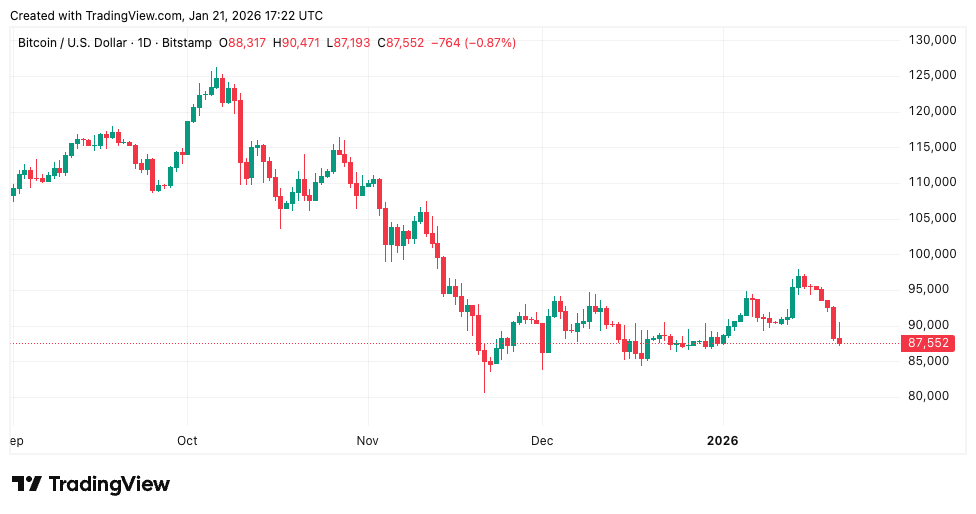
Greenland Tariff Threats Bitcoin - Bitcoin Price ChartSource: TradingView

The crypto market shed nearly $150 billion in market capitalization as leveraged positions unwound violently, exposing Bitcoin’s continued treatment as a speculative asset rather than the safe haven its proponents claim it to be.

Tariff Shock Drives Historic Divergence

Trump’s Saturday announcement targeted Germany, France, the UK, the Netherlands, Finland, Sweden, Norway, and Denmark with 10% tariffs starting February 1, escalating to 25% by June 1, unless a Greenland deal is reached.

ING economists warned that “additional tariffs of 25% would probably shave 0.2 percentage points off European GDP growth,” compounding recession fears already gripping the continent.

The tariff threat effectively reopened the trade war between the EU and the U.S., despite a temporary truce reached in late July, raising the stakes and bringing a far tougher approach.

European officials brought forward the option of activating the so-called anti-coercion instrument, the EU’s trade “bazooka“, allowing the bloc to impose tariffs and investment limits on offending nations.

French President Emmanuel Macron announced he would request the instrument’s activation, while Manfred Weber from the European Parliament’s largest party indicated the July deal was now “on ice.”

European countries hold approximately $8 trillion in U.S. bonds and stocks, making Europe by far the largest U.S. lender and exposing the deep interdependence that could turn this standoff into a full-blown crisis.

Germany’s export-reliant economy faces particularly acute pressure, with ING economist Carsten Brzeski warning the new tariffs would be “absolute poison” for the fragile recovery underway.

German exports to the United States fell 9.4% from January to November compared with a year earlier, and the trade surplus dropped to its lowest level since 2021.

Meanwhile, gold’s parabolic rally pushed prices past $4,800 per ounce to all-time highs.

TD Securities’ Daniel Ghali told Bloomberg that “gold’s rally is about trust. For now, trust has bent, but hasn’t broken. If it breaks, momentum will persist for longer.

Crypto Markets Suffer Violent Unwind

Bitcoin’s collapse alongside traditional risk assets exposed the crypto’s failure to serve as a geopolitical hedge, despite years of positioning as “digital gold.”

CoinGlass liquidation data revealed $998.33 million in long positions wiped out over 24 hours, with Bitcoin accounting for $440.19 million as cascading margin calls accelerated during thin Asian trading hours.

Galaxy Digital’s Alex Thorn noted that “Bitcoin isn’t quite doing the thing that it’s built to do, at least in real time,” while Bitunix analyst Dean Chen observed that “among crypto-native investors, it is increasingly framed as a geopolitical hedge and a non-sovereign store of value.”

However, for the broader market, Bitcoin is still largely traded as a high-beta risk asset,” he concluded.

Derivatives markets paint an increasingly bearish picture for the months ahead.

Sean Dawson of Derive.xyz warned that “rising geopolitical tensions between the US and Europe—particularly around Greenland—raise the risk of a regime shift back into a higher-volatility environment, a dynamic not currently reflected in spot prices.

Options data shows strong put open interest concentrated across the $75K-$85K strikes for the June 26 expiry, with Dawson noting that “from an options perspective, the outlook remains mildly bearish through mid-year. Traders are paying a premium for downside protection.

Bloomberg Intelligence strategist Mike McGlone delivered an even more dire assessment, warning that Bitcoin’s inability to hold long-term averages in 2025 suggests the price could eventually drop as low as $10,000.

Duke University’s Campbell Harvey also claimed in academic research that Bitcoin “is hardly a safe-haven asset,” noting its correlation with gold has broken down completely.

Institutional Demand Offers Potential Floor

Despite the bearish technical picture, not all analysts have turned pessimistic.

MEXC data showed that on January 16 alone, Bitcoin ETFs added 1,474 BTC, accounting for $1.48 billion in weekly inflows, while 36,800 BTC left exchanges.

These are signs of strong institutional demand and tightening supply that could limit downside.

In fact, as Cryptonews noted recently, the chance of Trump turning back on the tariff decision is high, with 86%, and that would greatly benefit Bitcoin after February 1.

Speaking with Cryptonews, Bitfinex analysts also noted that “Bitcoin spot volumes remain normal, funding rates are close to neutral, and there has been no spike in exchange inflows that would signal reactive selling,” suggesting the selloff reflects macro-linked noise rather than a crypto-specific catalyst.

For now, whether Bitcoin’s current consolidation represents capitulation or merely the calm before a deeper storm remains the central question facing crypto markets as February approaches.

Market Opportunity
Suilend Logo
Suilend Price(SEND)
$0.1298
$0.1298$0.1298
-5.66%
USD
Suilend (SEND) Live Price Chart
Disclaimer: The articles reposted on this site are sourced from public platforms and are provided for informational purposes only. They do not necessarily reflect the views of MEXC. All rights remain with the original authors. If you believe any content infringes on third-party rights, please contact service@support.mexc.com for removal. MEXC makes no guarantees regarding the accuracy, completeness, or timeliness of the content and is not responsible for any actions taken based on the information provided. The content does not constitute financial, legal, or other professional advice, nor should it be considered a recommendation or endorsement by MEXC.

You May Also Like

21Shares Launches JitoSOL Staking ETP on Euronext for European Investors

21Shares Launches JitoSOL Staking ETP on Euronext for European Investors

21Shares launches JitoSOL staking ETP on Euronext, offering European investors regulated access to Solana staking rewards with additional yield opportunities.Read
Share
Coinstats2026/01/30 12:53
Digital Asset Infrastructure Firm Talos Raises $45M, Valuation Hits $1.5 Billion

Digital Asset Infrastructure Firm Talos Raises $45M, Valuation Hits $1.5 Billion

Robinhood, Sony and trading firms back Series B extension as institutional crypto trading platform expands into traditional asset tokenization
Share
Blockhead2026/01/30 13:30
Summarize Any Stock’s Earnings Call in Seconds Using FMP API

Summarize Any Stock’s Earnings Call in Seconds Using FMP API

Turn lengthy earnings call transcripts into one-page insights using the Financial Modeling Prep APIPhoto by Bich Tran Earnings calls are packed with insights. They tell you how a company performed, what management expects in the future, and what analysts are worried about. The challenge is that these transcripts often stretch across dozens of pages, making it tough to separate the key takeaways from the noise. With the right tools, you don’t need to spend hours reading every line. By combining the Financial Modeling Prep (FMP) API with Groq’s lightning-fast LLMs, you can transform any earnings call into a concise summary in seconds. The FMP API provides reliable access to complete transcripts, while Groq handles the heavy lifting of distilling them into clear, actionable highlights. In this article, we’ll build a Python workflow that brings these two together. You’ll see how to fetch transcripts for any stock, prepare the text, and instantly generate a one-page summary. Whether you’re tracking Apple, NVIDIA, or your favorite growth stock, the process works the same — fast, accurate, and ready whenever you are. Fetching Earnings Transcripts with FMP API The first step is to pull the raw transcript data. FMP makes this simple with dedicated endpoints for earnings calls. If you want the latest transcripts across the market, you can use the stable endpoint /stable/earning-call-transcript-latest. For a specific stock, the v3 endpoint lets you request transcripts by symbol, quarter, and year using the pattern: https://financialmodelingprep.com/api/v3/earning_call_transcript/{symbol}?quarter={q}&year={y}&apikey=YOUR_API_KEY here’s how you can fetch NVIDIA’s transcript for a given quarter: import requestsAPI_KEY = "your_api_key"symbol = "NVDA"quarter = 2year = 2024url = f"https://financialmodelingprep.com/api/v3/earning_call_transcript/{symbol}?quarter={quarter}&year={year}&apikey={API_KEY}"response = requests.get(url)data = response.json()# Inspect the keysprint(data.keys())# Access transcript contentif "content" in data[0]: transcript_text = data[0]["content"] print(transcript_text[:500]) # preview first 500 characters The response typically includes details like the company symbol, quarter, year, and the full transcript text. If you aren’t sure which quarter to query, the “latest transcripts” endpoint is the quickest way to always stay up to date. Cleaning and Preparing Transcript Data Raw transcripts from the API often include long paragraphs, speaker tags, and formatting artifacts. Before sending them to an LLM, it helps to organize the text into a cleaner structure. Most transcripts follow a pattern: prepared remarks from executives first, followed by a Q&A session with analysts. Separating these sections gives better control when prompting the model. In Python, you can parse the transcript and strip out unnecessary characters. A simple way is to split by markers such as “Operator” or “Question-and-Answer.” Once separated, you can create two blocks — Prepared Remarks and Q&A — that will later be summarized independently. This ensures the model handles each section within context and avoids missing important details. Here’s a small example of how you might start preparing the data: import re# Example: using the transcript_text we fetched earliertext = transcript_text# Remove extra spaces and line breaksclean_text = re.sub(r'\s+', ' ', text).strip()# Split sections (this is a heuristic; real-world transcripts vary slightly)if "Question-and-Answer" in clean_text: prepared, qna = clean_text.split("Question-and-Answer", 1)else: prepared, qna = clean_text, ""print("Prepared Remarks Preview:\n", prepared[:500])print("\nQ&A Preview:\n", qna[:500]) With the transcript cleaned and divided, you’re ready to feed it into Groq’s LLM. Chunking may be necessary if the text is very long. A good approach is to break it into segments of a few thousand tokens, summarize each part, and then merge the summaries in a final pass. Summarizing with Groq LLM Now that the transcript is clean and split into Prepared Remarks and Q&A, we’ll use Groq to generate a crisp one-pager. The idea is simple: summarize each section separately (for focus and accuracy), then synthesize a final brief. Prompt design (concise and factual) Use a short, repeatable template that pushes for neutral, investor-ready language: You are an equity research analyst. Summarize the following earnings call sectionfor {symbol} ({quarter} {year}). Be factual and concise.Return:1) TL;DR (3–5 bullets)2) Results vs. guidance (what improved/worsened)3) Forward outlook (specific statements)4) Risks / watch-outs5) Q&A takeaways (if present)Text:<<<{section_text}>>> Python: calling Groq and getting a clean summary Groq provides an OpenAI-compatible API. Set your GROQ_API_KEY and pick a fast, high-quality model (e.g., a Llama-3.1 70B variant). We’ll write a helper to summarize any text block, then run it for both sections and merge. import osimport textwrapimport requestsGROQ_API_KEY = os.environ.get("GROQ_API_KEY") or "your_groq_api_key"GROQ_BASE_URL = "https://api.groq.com/openai/v1" # OpenAI-compatibleMODEL = "llama-3.1-70b" # choose your preferred Groq modeldef call_groq(prompt, temperature=0.2, max_tokens=1200): url = f"{GROQ_BASE_URL}/chat/completions" headers = { "Authorization": f"Bearer {GROQ_API_KEY}", "Content-Type": "application/json", } payload = { "model": MODEL, "messages": [ {"role": "system", "content": "You are a precise, neutral equity research analyst."}, {"role": "user", "content": prompt}, ], "temperature": temperature, "max_tokens": max_tokens, } r = requests.post(url, headers=headers, json=payload, timeout=60) r.raise_for_status() return r.json()["choices"][0]["message"]["content"].strip()def build_prompt(section_text, symbol, quarter, year): template = """ You are an equity research analyst. Summarize the following earnings call section for {symbol} ({quarter} {year}). Be factual and concise. Return: 1) TL;DR (3–5 bullets) 2) Results vs. guidance (what improved/worsened) 3) Forward outlook (specific statements) 4) Risks / watch-outs 5) Q&A takeaways (if present) Text: <<< {section_text} >>> """ return textwrap.dedent(template).format( symbol=symbol, quarter=quarter, year=year, section_text=section_text )def summarize_section(section_text, symbol="NVDA", quarter="Q2", year="2024"): if not section_text or section_text.strip() == "": return "(No content found for this section.)" prompt = build_prompt(section_text, symbol, quarter, year) return call_groq(prompt)# Example usage with the cleaned splits from Section 3prepared_summary = summarize_section(prepared, symbol="NVDA", quarter="Q2", year="2024")qna_summary = summarize_section(qna, symbol="NVDA", quarter="Q2", year="2024")final_one_pager = f"""# {symbol} Earnings One-Pager — {quarter} {year}## Prepared Remarks — Key Points{prepared_summary}## Q&A Highlights{qna_summary}""".strip()print(final_one_pager[:1200]) # preview Tips that keep quality high: Keep temperature low (≈0.2) for factual tone. If a section is extremely long, chunk at ~5–8k tokens, summarize each chunk with the same prompt, then ask the model to merge chunk summaries into one section summary before producing the final one-pager. If you also fetched headline numbers (EPS/revenue, guidance) earlier, prepend them to the prompt as brief context to help the model anchor on the right outcomes. Building the End-to-End Pipeline At this point, we have all the building blocks: the FMP API to fetch transcripts, a cleaning step to structure the data, and Groq LLM to generate concise summaries. The final step is to connect everything into a single workflow that can take any ticker and return a one-page earnings call summary. The flow looks like this: Input a stock ticker (for example, NVDA). Use FMP to fetch the latest transcript. Clean and split the text into Prepared Remarks and Q&A. Send each section to Groq for summarization. Merge the outputs into a neatly formatted earnings one-pager. Here’s how it comes together in Python: def summarize_earnings_call(symbol, quarter, year, api_key, groq_key): # Step 1: Fetch transcript from FMP url = f"https://financialmodelingprep.com/api/v3/earning_call_transcript/{symbol}?quarter={quarter}&year={year}&apikey={api_key}" resp = requests.get(url) resp.raise_for_status() data = resp.json() if not data or "content" not in data[0]: return f"No transcript found for {symbol} {quarter} {year}" text = data[0]["content"] # Step 2: Clean and split clean_text = re.sub(r'\s+', ' ', text).strip() if "Question-and-Answer" in clean_text: prepared, qna = clean_text.split("Question-and-Answer", 1) else: prepared, qna = clean_text, "" # Step 3: Summarize with Groq prepared_summary = summarize_section(prepared, symbol, quarter, year) qna_summary = summarize_section(qna, symbol, quarter, year) # Step 4: Merge into final one-pager return f"""# {symbol} Earnings One-Pager — {quarter} {year}## Prepared Remarks{prepared_summary}## Q&A Highlights{qna_summary}""".strip()# Example runprint(summarize_earnings_call("NVDA", 2, 2024, API_KEY, GROQ_API_KEY)) With this setup, generating a summary becomes as simple as calling one function with a ticker and date. You can run it inside a notebook, integrate it into a research workflow, or even schedule it to trigger after each new earnings release. Free Stock Market API and Financial Statements API... Conclusion Earnings calls no longer need to feel overwhelming. With the Financial Modeling Prep API, you can instantly access any company’s transcript, and with Groq LLM, you can turn that raw text into a sharp, actionable summary in seconds. This pipeline saves hours of reading and ensures you never miss the key results, guidance, or risks hidden in lengthy remarks. Whether you track tech giants like NVIDIA or smaller growth stocks, the process is the same — fast, reliable, and powered by the flexibility of FMP’s data. Summarize Any Stock’s Earnings Call in Seconds Using FMP API was originally published in Coinmonks on Medium, where people are continuing the conversation by highlighting and responding to this story
Share
Medium2025/09/18 14:40