Top Stories of The Week
Michael Saylor pushes back on criticism of Bitcoin treasury companies
Strategy chairman Michael Saylor defended Bitcoin treasury companies against criticism during a recent appearance on the What Bitcoin Did podcast.
Responding to questions about smaller companies that issue equity or debt to buy Bitcoin, Saylor said the decision ultimately comes down to capital allocation, arguing that companies with excess cash are better off allocating it to Bitcoin than holding it in treasuries or returning it to shareholders.
He compared corporate treasury strategies to individual investing, arguing that ownership levels vary but the underlying decision to hold BTC is rational regardless of company size or business model.
Saylor also pushed back on the idea that unprofitable companies should be singled out for criticism, arguing that Bitcoin holdings can help offset weak operating results.
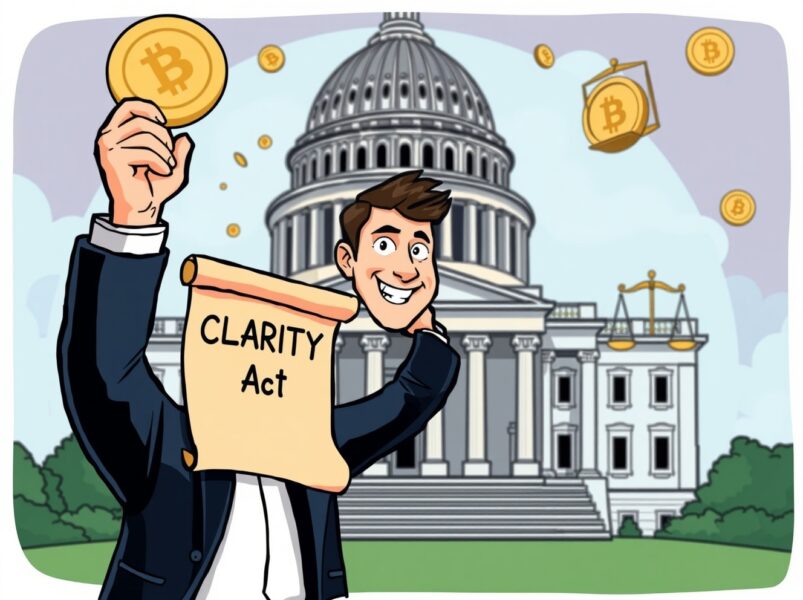
Goldman Sachs CEO says CLARITY Act ‘has a long way to go‘
David Solomon, CEO of banking giant Goldman Sachs, has weighed in on the pending digital asset market structure legislation, action on which was recently postponed by the US Senate Banking Committee.
In a Thursday earnings call discussing the company’s fourth quarter results for 2025, Solomon said many people at Goldman Sachs were “extremely focused” on issues including the Digital Asset Market Clarity (CLARITY) Act in the US Congress due to its potential impact on tokenization and stablecoins.
A markup of the bill scheduled for Thursday was postponed after Coinbase said it would no longer support the legislation as written. In a markup session, a congressional committee debates a bill and proposes amendments while considering whether it should advance to the full chamber for a vote.
US lawmakers press SEC over paused Justin Sun enforcement case
Three Democrats in the House of Representatives are asking US Securities and Exchange Commission (SEC) Chair Paul Atkins to provide information related to the agency closing investigations, dismissing enforcement actions, or pausing cases through extended stays in “at least one dozen crypto-related cases,” including Tron founder Justin Sun.
In a Thursday letter to Atkins, Representatives Maxine Waters, Brad Sherman and Sean Casten questioned the SEC’s “priorities and effectiveness” given its dismissals of the crypto-related cases. The lawmakers wrote that the agency had “openly and boldly dismissed the majority of its crypto enforcement cases,” including cases involving crypto exchanges Binance, Coinbase and Kraken.
Zcash Foundation says SEC closed 2023 probe into privacy coin
The foundation behind Zcash said that the US Securities and Exchange Commission (SEC) will not pursue an enforcement action against the privacy coin after the end of an investigation launched in 2023.
In a Wednesday notice, the Zcash Foundation said the SEC “concluded its review” over a “matter of certain crypto asset offerings” and would not recommend enforcement actions or changes. According to the foundation, the regulatory probe started in August 2023 after it received a subpoena from the SEC.
“This outcome reflects our commitment to transparency and compliance with applicable regulatory requirements,” said the foundation. “Zcash Foundation remains focused on advancing privacy-preserving financial infrastructure for the public good.”
Crypto’s 2026 comeback hinges on three outcomes, Wintermute says
Last year proved disappointing for many cryptocurrency investors, as Bitcoin’s traditional four-year cycle delivered a muted rally that failed to spill over into the broader altcoin market. According to crypto market maker Wintermute, the shift reflects a structural change rather than a temporary pause, leaving any recovery in 2026 dependent on several uncertain factors.
In its digital asset OTC market review, Wintermute said the market’s long-standing pattern of “recycling,” in which gains in Bitcoin flowed into altcoins and fueled extended, narrative-driven rallies, broke down in 2025.
Instead, liquidity concentrated in a small group of large-cap assets, driven largely by exchange-traded funds and institutional inflows. The result was narrower market breadth and sharper divergence in performance, suggesting that capital became more selective rather than broadly rotating across the market.
Most Memorable Quotations
“We have received confirmation from DOJ that the digital assets forfeited by Samourai Wallet have not been liquidated and will not be liquidated.”
Patrick Witt, executive director of the US President’s Council of Advisors for Digital Assets
“You somehow think that it’s OK for 400 million companies to not buy Bitcoin, and somehow that’s okay, and you’re going to criticize the 200 companies that bought Bitcoin.”
Michael Saylor, executive chairman of Strategy
“If gold and the Nasdaq have the juice, how is Bitcoin going to get its groove back? Dollar liquidity must expand for that to happen.”
Arthur Hayes, co-founder of BitMEX
“It’s not perfect, and changes are needed before it becomes law. But now is the time to move the CLARITY Act forward if we want the US to remain the best place in the world to build the future of crypto.”
Chris Dixon, managing partner at a16z Crypto
“With BTC rising in a low-leverage environment, it feels like a lot of last year’s fluff was taken out, leaving bulls a tad more realistic, and bears tamed in their apocalyptic prophecies. We see a lot of indicators in deep oversold territory, edging to get back up.”
VanEck, global investment management firm
“We are the ‘hottest’ country in the world, and number one in AI. Data centers are key to that boom, and keeping Americans free and secure, but the big technology companies who build them must ‘pay their own way.”
Donald Trump, president of the United States of America
Winners and Losers
At the end of the week, Bitcoin (BTC) is at $95,447, Ether (ETH) at $3,291 and XRP at $2.06. The total market cap is at $3.23 trillion, according to CoinMarketCap.
Among the biggest 100 cryptocurrencies, the top three altcoin gainers of the week are Dash (DASH) at 123.17%, Monero (XMR) at 35.43% and Story (IP) at 34.65%.
The top three altcoin losers of the week are Lighter (LIT) at 34.57%, XDC Network (XDC) at 8.51% and Polygon (POL) at 8.50%. For more info on crypto prices, make sure to read Cointelegraph’s market analysis.
Top Prediction of The Week
Bitcoin traders predict ‘strong run-up’ as classic chart targets $113K
As Cointelegraph reported, Bitcoin’s ability to return to a six-figure price hinges on overcoming the resistance at $98,000 — the short-term holder (STH) cost basis.
This is the critical point on traders’ radar and one that has not received a convincing retest recently.
“$BTC is approaching a key inflexion point,” said Glassnode analyst Chris Beamish in a Friday post on X, adding: “Reclaiming the STH cost basis would signal that recent buyers are back in profit, typically a prerequisite for momentum to re-accelerate.”
Top FUD of The Week
Jefferies’ ‘Greed & Fear’ strategist cuts Bitcoin allocation to zero on quantum risk
Investment bank Jefferies’ longtime “Greed & Fear” strategist Christopher Wood has reportedly eliminated Bitcoin from his flagship model portfolio, citing mounting concerns that advances in quantum computing may undermine the cryptocurrency’s long-term security.
According to a report by Bloomberg, Wood said in the latest edition of his Greed & Fear newsletter, that the 10% Bitcoin allocation he first added in late 2020 has been replaced by a split position in physical gold and gold mining stocks.
He argued that quantum breakthroughs would weaken Bitcoin’s claim to be a dependable store of value for pension‑style investors.
Wood added that concern over quantum risk is rising among long-term, institutional investors, warning that some capital allocators now question Bitcoin’s “store of value” case if quantum timelines compress.
Crypto exchanges face ban in South Korea as Google Play updates rules
Google is rolling out updated crypto app requirements in South Korea, a move that may significantly restrict access to offshore crypto exchanges by tying app availability to local regulatory clearance.
Read also
Features
This is how to make — and lose — a fortune with NFTs
Features
Pink Drainer creator defends his wallet draining crypto scam kit
According to South Korean media outlet News1, starting Jan. 28, crypto exchange and wallet apps listed on Google Play in South Korea must upload documentation proving that their Virtual Asset Service Provider registration with the country’s Financial Intelligence Unit (FIU) has been accepted.
Google reportedly clarified that developers listing crypto exchange and custodial wallet apps must upload proof of completed FIU registration acceptance through its developer console.
Apps that fail to meet the requirement may be blocked in South Korea, preventing new downloads and potentially disrupting access over time.
Polygon trims workforce amid $250M stablecoin payments pivot
Polygon Labs has cut personnel as it pivots more aggressively to a payments-first strategy built around stablecoin rails and what it calls an “Open Money Stack,” a new, vertically integrated set of services designed to move money onchain.
Read also
Features
Who takes gold in the crypto and blockchain Olympics?
Features
Should you ‘orange pill’ children? The case for Bitcoin kids books
The layoffs came just days after announcing a deal worth as much as $250 million to acquire US crypto ATM and payments company Coinme and wallet and developer platform Sequence.
Polygon did not publicly disclose how many roles were eliminated, but according to multiple sources on social media platforms like X, a reduction as large of 30% in staff has been linked to the post‑acquisition integration.
Top Magazine Stories of The Week
Here’s why crypto is moving to Dubai and Abu Dhabi
Dubai and Abu Dhabi in the UAE are going all out to attract crypto’s wealthiest people and biggest companies.
Bitcoin ‘bullish’ in Q1 says Willy Woo, XRP lacks CLARITY: Trade Secrets
Willy Woo confident in Bitcoin’s price short-term… but there’s a catch. Analysts say ETH set for new multi-year cycle, but Polymarket disagrees.
Grok faces bans… but 8 lawsuits claim ChatGPT use can kill: AI Eye
Scottish trolls fall silent due to Iranian internet blackout — and why you shouldn’t take directions from a robot during a fire.
Subscribe
The most engaging reads in blockchain. Delivered once a
week.
Source: https://cointelegraph.com/magazine/michael-saylor-bitcoin-treasury-company-us-clarity-act-zcash-hodlers-digest/?utm_source=rss_feed&utm_medium=feed&utm_campaign=rss_partner_inbound