Author: Aki Wu on Blockchain On September 8, 2025, Nasdaq submitted a landmark proposal to the U.S. Securities and Exchange Commission (SEC), seeking to amend its exchange rules to allow tokenized securities to be traded on its market. This means that Nasdaq-listed US stocks like Apple and Amazon could potentially be listed, traded, and settled on Nasdaq in the form of blockchain tokens. If approved, this proposal would be the first time a major US stock exchange has permitted tokenized stock trading, marking the first large-scale introduction of blockchain technology into the core markets of Wall Street. This article will systematically review the key points of Nasdaq's proposal, the motivations behind it, the potential market shifts it could bring, its impact on the "US stock blockchain" initiative and related sectors, and explore the potential development paths for this innovative initiative. Proposal Highlights: Detailed Explanation of Nasdaq Trading Rules Amendments The core of Nasdaq's 19b-4 Rule amendments submitted to the SEC is to allow member brokerages and investors to choose to trade and settle Nasdaq-listed equity securities and exchange-traded products (ETPs) in tokenized form. Specifically, the rule amendments include the following: 1. Expanding the definition of “securities” to include tokenized forms of securities in Equity 1, Section 1 The proposal first amended the exchange’s definition of “securities,” emphasizing that “tokenized securities are still securities,” rejecting the “isolated” trading model that is decoupled from the main market and expanding it to include two forms: Traditional form: This refers to a digital record of asset ownership and rights, but does not utilize distributed ledgers or blockchain technology. This refers to the electronic record-keeping method currently used in US stocks, which essentially still corresponds to the electronic registration of paper securities. Tokenization: This refers to the digital representation of asset ownership and rights, recorded and transferred using blockchain (distributed ledger) technology. Simply put, the rights associated with a stock are issued on the blockchain and represented as tokens. Nasdaq explicitly stipulates that a tokenized security is considered an equivalent security and can be traded on the same order book as its traditional counterpart only if it is fully homogeneous. This means that the token must be fungible with traditional shares, share the same CUSIP (Uniform Securities Identification Number), and confer upon the holder the same substantive rights and privileges as traditional shares—including rights to equity returns, dividends, voting rights, and the right to distribute residual assets upon liquidation. If the tokenized security does not confer the same rights as the original share (e.g., no voting rights, no shareholder equity), or does not share the same CUSIP, the exchange will not treat it as equivalent to the traditional security and will instead treat it as a different product, such as a derivative or American Depositary Receipt (ADR). Because of this high standard, most so-called "tokenized stocks" currently on the market, such as Robinhood "Stock Tokens" and Xstocks, do not actually meet the above conditions. At best, they are just shadow tokens that reflect stock prices, do not represent real equity, and usually do not confer voting rights; dividends are mostly reflected in the form of reinvestment or cash equivalents; the legal relationship is mostly directed to the SPV or issuing vehicle rather than the listed company itself, and most products are mainly redeemed in cash. Direct "exchange for original shares" will be subject to custody and compliance restrictions. 2. Unified matching and distributed settlement: trading and clearing mechanism Equity 4, Rule 4757 Nasdaq plans to fully integrate tokenized securities with traditional securities at the trading level. The proposal stipulates that as long as the tokenized version of a stock meets the aforementioned homogeneity requirements, it will share the same order book as traditional stocks and be matched according to the same order matching and priority rules. In other words, the exchange's matching engine will treat tokenized and non-tokenized buy and sell orders equally. Indeed, Nasdaq emphasizes that "at the trading stage, there is no difference between the two; the fundamental trade execution process is identical." Equity 4, Rule 4756、4758 The difference lies in the settlement process. Currently, U.S. stock transactions are typically cleared and settled through the Depository Trust Company (DTC). By introducing tokenization, Nasdaq will offer trading participants a new option: they can use tokens for settlement. The specific process is as follows: When brokers enter orders with the exchange, they can choose to specify that they wish to have their orders settled in tokens. If the order is executed and marked as token-settled, Nasdaq will pass the clearing instructions for the trade to DTC, which will then execute the security transfer in the background via blockchain. DTC will register stock ownership as on-chain tokens based on its own business rules and systems (including its currently developing blockchain settlement platform). The entire process will be transparent to front-end investors. Trades will still be matched on Nasdaq, but clearing and settlement will shift from traditional electronic bookkeeping to blockchain-based registration. Ultimately, the shares will be held as tokens on-chain. It's worth noting that Nasdaq's move isn't about creating a new market from scratch. Instead, it's leveraging existing market infrastructure, introducing blockchain as the underlying record-keeping technology without altering front-end trading mechanisms. This ensures that traditional stocks and tokenized shares maintain unified prices during trading, share market depth and liquidity, and maintain consistent information transparency and risk management. As Nasdaq explains in its filing, this plan aims to prevent different versions of tokenized shares from operating independently on multiple blockchains, fragmenting liquidity and ensuring that core mechanisms of the national market system, such as price discovery and best execution, are not impacted. This approach addresses the pain points of tokenized shares, including the lack of liquidity caused by the fragmentation of market-making capital and order books, resulting from multiple chains (ETH/SOL, etc.), multiple markets (regulated on-exchange trading versus crypto exchanges/DEXs), and geographical compliance restrictions. 3. Trading hours: 24/7 trading is not currently available Since their launch, tokenized stocks have been plagued by issues of deep liquidity and high impact during US stock market holidays. This misalignment in trading hours has also contributed to insufficient liquidity and price decoupling. Consequently, many investors are concerned about whether tokenized stocks can transcend existing US stock market trading hours and achieve 24/7 trading. Nasdaq's proposal offers a cautious answer: at this stage, tokenized securities will only be traded during existing trading hours, with no extensions or breaks in trading hours. Tokenized stocks cannot be traded outside of regular or extended trading hours, and will continue to follow US stock market practices, trading only during regular trading hours (9:30–16:00) and pre- and post-market hours, Monday through Friday, Eastern Time. Weekend or late-night trading is not currently supported. 4. Implementation path of on-chain settlement Nasdaq's tokenized stock trading relies on the Depository Trust & Clearing Corporation (DTC), a core clearinghouse in traditional financial markets. Notably, DTC has been exploring distributed ledger technology (DLT) clearing in recent years. Its "Project Ion" is a blockchain-based stock settlement platform designed to achieve T+0 and even real-time delivery. According to public information, Project Ion launched in a parallel pilot environment in 2022 and processes settlement instructions for over 100,000 stock trades daily. DTC developed the platform in collaboration with enterprise blockchain technology provider R3, using R3's Corda distributed ledger software and building a private permissioned blockchain as its underlying architecture. This network is a non-public consortium blockchain. This suggests that Nasdaq's tokenized transactions are more likely to be run on DTC's permissioned blockchain platform, rather than on public blockchains such as Ethereum, which have been widely discussed in the community. This would allow DTC to maintain its legacy system as the authoritative record, running it in parallel with the new DLT system to ensure security redundancy. Therefore, under Nasdaq's proposal, on-chain settlement would likely occur within a controlled "consortium blockchain" environment, with nodes maintained by financial infrastructure operators such as DTC. This ensures transaction privacy, network reliability, and regulatory control, meeting Wall Street's high standards for trade settlement systems. Consortium blockchains allow participants to undergo access control, ensuring greater control over data privacy and transaction speed, thus complying with regulatory requirements. Therefore, it is foreseeable that records of Nasdaq's tokenized shares will not appear on public blockchain explorers, but will instead be stored in a distributed ledger jointly maintained by Nasdaq, DTC, and related custodians. While Nasdaq has not specified the specifics of how its smart contracts will be deployed in its public documents, it is clear that Nasdaq does not intend to introduce a completely open token trading environment. Instead, it intends to utilize blockchain technology as a "behind-the-scenes" tool to enhance efficiency, while front-end transactions will still occur within a controlled system. The only change is to use blockchain records for bookkeeping. This means that investors will hold on-chain records approved by regulators, rather than crypto tokens that circulate freely outside the traditional system. Why did Nasdaq apply for tokenized securities? Blockchain has enormous potential to improve the efficiency of financial market infrastructure. Currently, US stock trades are settled on a delayed basis (T+1) (or T+2 in some markets). Blockchain technology can achieve near-real-time settlement (T+0 or even within seconds), reducing the time it takes for funds and securities to be held, and mitigating counterparty risk. Furthermore, blockchain's transparent and immutable distributed ledger provides a comprehensive audit trail, reducing reconciliation and manual errors. Nasdaq hopes to introduce tokenized settlement to expedite post-trade processes while reducing costs in clearing and custody. This is an attempt to revolutionize securities settlement mechanisms from the ground up. Nasdaq stated in its filing: "Today, securities, including stocks, have evolved from paper to electronic records, and tokenization is simply another method of digitally representing assets." By embracing blockchain, exchanges have demonstrated their determination to promote financial technology innovation so as not to fall behind in the new wave of technology. It is expected that the scale of the asset tokenization market is experiencing explosive growth, and the total market value of global tokenized assets will soar from approximately US$2.1 trillion in 2024 to approximately US$41.9 trillion in 2032, with a compound annual growth rate of 45.8%. Consequently, investors and issuers are showing strong interest in security tokenization, which represents a significant emerging market opportunity. Regulators and market participants in many countries are actively exploring the potential of blockchain-based securities, and the US cannot afford to lag behind. As a market organizer, Nasdaq hopes to capitalize on this trend, offering clients new trading options and thereby attracting more capital to the US market. By taking an early approach, Nasdaq can solidify its competitiveness in the digital asset era, especially as the White House actively promotes crypto-asset innovation and fosters a digital asset-friendly regulatory environment. It is crucial to ensure that tokenized securities develop within a compliant framework and prevent market fragmentation. As mentioned earlier, many tokenized stocks are currently traded on unregulated offshore platforms, lacking investor protections. Different platforms operate independently, leading to fragmented liquidity and market opacity. Nasdaq's proposal aims to incorporate these innovations into the mainstream regulatory system, thereby preventing investors from being drawn into unregulated markets by chasing novel concepts. While exchanges won't aggressively open up dazzling features in the short term, in the long term, stock tokenization opens up new possibilities for financial innovation. For example, stocks can be used as on-chain collateral in decentralized finance (DeFi), and equity tokens can be programmatically integrated into smart contracts to automate dividends, voting, and even the creation of entirely new derivatives and index products. These scenarios, difficult to achieve under traditional architectures, are expected to gradually become possible with tokenization. However, it's important to note that Nasdaq's tokenized securities trading venue remains on Nasdaq, meaning it's brokered within a compliant, centralized environment. This doesn't mean anyone can trade anonymously and freely on-chain. Conclusion: Long-term opportunities and industry outlook Nasdaq's promotion of tokenized securities trading is undoubtedly a major innovation in the underlying technology of securities trading. It marks a crucial step for traditional financial markets towards the blockchain era. From regulatory approval to technological preparation, this transformation will not be achieved overnight. According to Nasdaq's application documents, the relevant blockchain settlement infrastructure may not be ready until the end of the third quarter of 2026. Nasdaq anticipates that, assuming the proposal is approved by the SEC and the DTC's distributed ledger settlement system is launched, US investors could expect to see the first securities transactions settled in token form by the end of the third quarter of 2026. Investors need to recognize that this is a long-term theme. The GENIUS Act ushers in a new era of stablecoin compliance, and Nasdaq tokenized securities could become the next game-changing milestone. In the coming years, policy advancements and technological milestones related to this theme will continue to be a market focus, fostering cyclical investment opportunities in sectors such as oracles and RWAs. As Nasdaq management has stated, innovation should occur within national market systems to protect investors, not in the unregulated offshore wilderness. As Nasdaq tokenized stocks gradually launch, it will unlock greater potential for institutional capital to participate in on-chain equities. For example, large institutions can obtain real stock tokens through official channels and then confidently invest them in DeFi to generate returns. This represents a high level of capital that shadow token platforms currently struggle to attract. For the average user, once sovereign-level exchanges offer compliant stock tokens, holding shadow versions without shareholder rights becomes unnecessary. While the prospects are promising, potential limitations must be addressed. First, in the initial stages, the direct benefits for average investors may be limited. Currently, US retail investors can easily trade stocks through brokerages, and Nasdaq's tokenization will not immediately significantly reduce their trading costs or barriers to entry. While benefits such as 24/7 trading are not necessarily desirable for non-professional investors, they may not want to be constantly trading and experiencing volatility. Smart contracts are also subject to the risk of vulnerabilities and hacking, and if problems arise with tokenized stock contracts, it remains unclear who will bear liability. Furthermore, significant price deviations have been observed in some unregulated tokenized stock transactions abroad, exposing issues of insufficient liquidity and potential manipulation. Under Nasdaq's proposal, these deviations are expected to be reduced because the tokens are backed by real stocks and traditional market makers participate in pricing. Nasdaq's tokenized stock trading will mark a major milestone in the commercial application of blockchain technology. It signifies that blockchain is no longer confined to the cryptocurrency world, but has truly entered the core landscape of mainstream finance. From an industry perspective, this is an authoritative endorsement of the blockchain and Web3 ecosystem, inspiring more companies and developers to invest in this field. From a financial history perspective, this event may be seen as the starting point for the digital transformation of the traditional securities market, similar to the transition of exchanges from paper-based trading to electronic trading decades ago. For the Web3 community, this is an opportunity to put ideals into practice: concepts like decentralization and tokenization can only unlock their greatest value when integrated with the real economy. While this may not be the most utopian outcome for purist decentralization enthusiasts, it has significantly advanced the process of large-scale blockchain adoption.Author: Aki Wu on Blockchain On September 8, 2025, Nasdaq submitted a landmark proposal to the U.S. Securities and Exchange Commission (SEC), seeking to amend its exchange rules to allow tokenized securities to be traded on its market. This means that Nasdaq-listed US stocks like Apple and Amazon could potentially be listed, traded, and settled on Nasdaq in the form of blockchain tokens. If approved, this proposal would be the first time a major US stock exchange has permitted tokenized stock trading, marking the first large-scale introduction of blockchain technology into the core markets of Wall Street. This article will systematically review the key points of Nasdaq's proposal, the motivations behind it, the potential market shifts it could bring, its impact on the "US stock blockchain" initiative and related sectors, and explore the potential development paths for this innovative initiative. Proposal Highlights: Detailed Explanation of Nasdaq Trading Rules Amendments The core of Nasdaq's 19b-4 Rule amendments submitted to the SEC is to allow member brokerages and investors to choose to trade and settle Nasdaq-listed equity securities and exchange-traded products (ETPs) in tokenized form. Specifically, the rule amendments include the following: 1. Expanding the definition of “securities” to include tokenized forms of securities in Equity 1, Section 1 The proposal first amended the exchange’s definition of “securities,” emphasizing that “tokenized securities are still securities,” rejecting the “isolated” trading model that is decoupled from the main market and expanding it to include two forms: Traditional form: This refers to a digital record of asset ownership and rights, but does not utilize distributed ledgers or blockchain technology. This refers to the electronic record-keeping method currently used in US stocks, which essentially still corresponds to the electronic registration of paper securities. Tokenization: This refers to the digital representation of asset ownership and rights, recorded and transferred using blockchain (distributed ledger) technology. Simply put, the rights associated with a stock are issued on the blockchain and represented as tokens. Nasdaq explicitly stipulates that a tokenized security is considered an equivalent security and can be traded on the same order book as its traditional counterpart only if it is fully homogeneous. This means that the token must be fungible with traditional shares, share the same CUSIP (Uniform Securities Identification Number), and confer upon the holder the same substantive rights and privileges as traditional shares—including rights to equity returns, dividends, voting rights, and the right to distribute residual assets upon liquidation. If the tokenized security does not confer the same rights as the original share (e.g., no voting rights, no shareholder equity), or does not share the same CUSIP, the exchange will not treat it as equivalent to the traditional security and will instead treat it as a different product, such as a derivative or American Depositary Receipt (ADR). Because of this high standard, most so-called "tokenized stocks" currently on the market, such as Robinhood "Stock Tokens" and Xstocks, do not actually meet the above conditions. At best, they are just shadow tokens that reflect stock prices, do not represent real equity, and usually do not confer voting rights; dividends are mostly reflected in the form of reinvestment or cash equivalents; the legal relationship is mostly directed to the SPV or issuing vehicle rather than the listed company itself, and most products are mainly redeemed in cash. Direct "exchange for original shares" will be subject to custody and compliance restrictions. 2. Unified matching and distributed settlement: trading and clearing mechanism Equity 4, Rule 4757 Nasdaq plans to fully integrate tokenized securities with traditional securities at the trading level. The proposal stipulates that as long as the tokenized version of a stock meets the aforementioned homogeneity requirements, it will share the same order book as traditional stocks and be matched according to the same order matching and priority rules. In other words, the exchange's matching engine will treat tokenized and non-tokenized buy and sell orders equally. Indeed, Nasdaq emphasizes that "at the trading stage, there is no difference between the two; the fundamental trade execution process is identical." Equity 4, Rule 4756、4758 The difference lies in the settlement process. Currently, U.S. stock transactions are typically cleared and settled through the Depository Trust Company (DTC). By introducing tokenization, Nasdaq will offer trading participants a new option: they can use tokens for settlement. The specific process is as follows: When brokers enter orders with the exchange, they can choose to specify that they wish to have their orders settled in tokens. If the order is executed and marked as token-settled, Nasdaq will pass the clearing instructions for the trade to DTC, which will then execute the security transfer in the background via blockchain. DTC will register stock ownership as on-chain tokens based on its own business rules and systems (including its currently developing blockchain settlement platform). The entire process will be transparent to front-end investors. Trades will still be matched on Nasdaq, but clearing and settlement will shift from traditional electronic bookkeeping to blockchain-based registration. Ultimately, the shares will be held as tokens on-chain. It's worth noting that Nasdaq's move isn't about creating a new market from scratch. Instead, it's leveraging existing market infrastructure, introducing blockchain as the underlying record-keeping technology without altering front-end trading mechanisms. This ensures that traditional stocks and tokenized shares maintain unified prices during trading, share market depth and liquidity, and maintain consistent information transparency and risk management. As Nasdaq explains in its filing, this plan aims to prevent different versions of tokenized shares from operating independently on multiple blockchains, fragmenting liquidity and ensuring that core mechanisms of the national market system, such as price discovery and best execution, are not impacted. This approach addresses the pain points of tokenized shares, including the lack of liquidity caused by the fragmentation of market-making capital and order books, resulting from multiple chains (ETH/SOL, etc.), multiple markets (regulated on-exchange trading versus crypto exchanges/DEXs), and geographical compliance restrictions. 3. Trading hours: 24/7 trading is not currently available Since their launch, tokenized stocks have been plagued by issues of deep liquidity and high impact during US stock market holidays. This misalignment in trading hours has also contributed to insufficient liquidity and price decoupling. Consequently, many investors are concerned about whether tokenized stocks can transcend existing US stock market trading hours and achieve 24/7 trading. Nasdaq's proposal offers a cautious answer: at this stage, tokenized securities will only be traded during existing trading hours, with no extensions or breaks in trading hours. Tokenized stocks cannot be traded outside of regular or extended trading hours, and will continue to follow US stock market practices, trading only during regular trading hours (9:30–16:00) and pre- and post-market hours, Monday through Friday, Eastern Time. Weekend or late-night trading is not currently supported. 4. Implementation path of on-chain settlement Nasdaq's tokenized stock trading relies on the Depository Trust & Clearing Corporation (DTC), a core clearinghouse in traditional financial markets. Notably, DTC has been exploring distributed ledger technology (DLT) clearing in recent years. Its "Project Ion" is a blockchain-based stock settlement platform designed to achieve T+0 and even real-time delivery. According to public information, Project Ion launched in a parallel pilot environment in 2022 and processes settlement instructions for over 100,000 stock trades daily. DTC developed the platform in collaboration with enterprise blockchain technology provider R3, using R3's Corda distributed ledger software and building a private permissioned blockchain as its underlying architecture. This network is a non-public consortium blockchain. This suggests that Nasdaq's tokenized transactions are more likely to be run on DTC's permissioned blockchain platform, rather than on public blockchains such as Ethereum, which have been widely discussed in the community. This would allow DTC to maintain its legacy system as the authoritative record, running it in parallel with the new DLT system to ensure security redundancy. Therefore, under Nasdaq's proposal, on-chain settlement would likely occur within a controlled "consortium blockchain" environment, with nodes maintained by financial infrastructure operators such as DTC. This ensures transaction privacy, network reliability, and regulatory control, meeting Wall Street's high standards for trade settlement systems. Consortium blockchains allow participants to undergo access control, ensuring greater control over data privacy and transaction speed, thus complying with regulatory requirements. Therefore, it is foreseeable that records of Nasdaq's tokenized shares will not appear on public blockchain explorers, but will instead be stored in a distributed ledger jointly maintained by Nasdaq, DTC, and related custodians. While Nasdaq has not specified the specifics of how its smart contracts will be deployed in its public documents, it is clear that Nasdaq does not intend to introduce a completely open token trading environment. Instead, it intends to utilize blockchain technology as a "behind-the-scenes" tool to enhance efficiency, while front-end transactions will still occur within a controlled system. The only change is to use blockchain records for bookkeeping. This means that investors will hold on-chain records approved by regulators, rather than crypto tokens that circulate freely outside the traditional system. Why did Nasdaq apply for tokenized securities? Blockchain has enormous potential to improve the efficiency of financial market infrastructure. Currently, US stock trades are settled on a delayed basis (T+1) (or T+2 in some markets). Blockchain technology can achieve near-real-time settlement (T+0 or even within seconds), reducing the time it takes for funds and securities to be held, and mitigating counterparty risk. Furthermore, blockchain's transparent and immutable distributed ledger provides a comprehensive audit trail, reducing reconciliation and manual errors. Nasdaq hopes to introduce tokenized settlement to expedite post-trade processes while reducing costs in clearing and custody. This is an attempt to revolutionize securities settlement mechanisms from the ground up. Nasdaq stated in its filing: "Today, securities, including stocks, have evolved from paper to electronic records, and tokenization is simply another method of digitally representing assets." By embracing blockchain, exchanges have demonstrated their determination to promote financial technology innovation so as not to fall behind in the new wave of technology. It is expected that the scale of the asset tokenization market is experiencing explosive growth, and the total market value of global tokenized assets will soar from approximately US$2.1 trillion in 2024 to approximately US$41.9 trillion in 2032, with a compound annual growth rate of 45.8%. Consequently, investors and issuers are showing strong interest in security tokenization, which represents a significant emerging market opportunity. Regulators and market participants in many countries are actively exploring the potential of blockchain-based securities, and the US cannot afford to lag behind. As a market organizer, Nasdaq hopes to capitalize on this trend, offering clients new trading options and thereby attracting more capital to the US market. By taking an early approach, Nasdaq can solidify its competitiveness in the digital asset era, especially as the White House actively promotes crypto-asset innovation and fosters a digital asset-friendly regulatory environment. It is crucial to ensure that tokenized securities develop within a compliant framework and prevent market fragmentation. As mentioned earlier, many tokenized stocks are currently traded on unregulated offshore platforms, lacking investor protections. Different platforms operate independently, leading to fragmented liquidity and market opacity. Nasdaq's proposal aims to incorporate these innovations into the mainstream regulatory system, thereby preventing investors from being drawn into unregulated markets by chasing novel concepts. While exchanges won't aggressively open up dazzling features in the short term, in the long term, stock tokenization opens up new possibilities for financial innovation. For example, stocks can be used as on-chain collateral in decentralized finance (DeFi), and equity tokens can be programmatically integrated into smart contracts to automate dividends, voting, and even the creation of entirely new derivatives and index products. These scenarios, difficult to achieve under traditional architectures, are expected to gradually become possible with tokenization. However, it's important to note that Nasdaq's tokenized securities trading venue remains on Nasdaq, meaning it's brokered within a compliant, centralized environment. This doesn't mean anyone can trade anonymously and freely on-chain. Conclusion: Long-term opportunities and industry outlook Nasdaq's promotion of tokenized securities trading is undoubtedly a major innovation in the underlying technology of securities trading. It marks a crucial step for traditional financial markets towards the blockchain era. From regulatory approval to technological preparation, this transformation will not be achieved overnight. According to Nasdaq's application documents, the relevant blockchain settlement infrastructure may not be ready until the end of the third quarter of 2026. Nasdaq anticipates that, assuming the proposal is approved by the SEC and the DTC's distributed ledger settlement system is launched, US investors could expect to see the first securities transactions settled in token form by the end of the third quarter of 2026. Investors need to recognize that this is a long-term theme. The GENIUS Act ushers in a new era of stablecoin compliance, and Nasdaq tokenized securities could become the next game-changing milestone. In the coming years, policy advancements and technological milestones related to this theme will continue to be a market focus, fostering cyclical investment opportunities in sectors such as oracles and RWAs. As Nasdaq management has stated, innovation should occur within national market systems to protect investors, not in the unregulated offshore wilderness. As Nasdaq tokenized stocks gradually launch, it will unlock greater potential for institutional capital to participate in on-chain equities. For example, large institutions can obtain real stock tokens through official channels and then confidently invest them in DeFi to generate returns. This represents a high level of capital that shadow token platforms currently struggle to attract. For the average user, once sovereign-level exchanges offer compliant stock tokens, holding shadow versions without shareholder rights becomes unnecessary. While the prospects are promising, potential limitations must be addressed. First, in the initial stages, the direct benefits for average investors may be limited. Currently, US retail investors can easily trade stocks through brokerages, and Nasdaq's tokenization will not immediately significantly reduce their trading costs or barriers to entry. While benefits such as 24/7 trading are not necessarily desirable for non-professional investors, they may not want to be constantly trading and experiencing volatility. Smart contracts are also subject to the risk of vulnerabilities and hacking, and if problems arise with tokenized stock contracts, it remains unclear who will bear liability. Furthermore, significant price deviations have been observed in some unregulated tokenized stock transactions abroad, exposing issues of insufficient liquidity and potential manipulation. Under Nasdaq's proposal, these deviations are expected to be reduced because the tokens are backed by real stocks and traditional market makers participate in pricing. Nasdaq's tokenized stock trading will mark a major milestone in the commercial application of blockchain technology. It signifies that blockchain is no longer confined to the cryptocurrency world, but has truly entered the core landscape of mainstream finance. From an industry perspective, this is an authoritative endorsement of the blockchain and Web3 ecosystem, inspiring more companies and developers to invest in this field. From a financial history perspective, this event may be seen as the starting point for the digital transformation of the traditional securities market, similar to the transition of exchanges from paper-based trading to electronic trading decades ago. For the Web3 community, this is an opportunity to put ideals into practice: concepts like decentralization and tokenization can only unlock their greatest value when integrated with the real economy. While this may not be the most utopian outcome for purist decentralization enthusiasts, it has significantly advanced the process of large-scale blockchain adoption.

Nasdaq Proposal Analysis: How Tokenized Securities Will Reshape the U.S. Stock Trading Ecosystem

2025/09/18 13:00
13 min read
For feedback or concerns regarding this content, please contact us at crypto.news@mexc.com

Author: Aki Wu on Blockchain

On September 8, 2025, Nasdaq submitted a landmark proposal to the U.S. Securities and Exchange Commission (SEC), seeking to amend its exchange rules to allow tokenized securities to be traded on its market. This means that Nasdaq-listed US stocks like Apple and Amazon could potentially be listed, traded, and settled on Nasdaq in the form of blockchain tokens. If approved, this proposal would be the first time a major US stock exchange has permitted tokenized stock trading, marking the first large-scale introduction of blockchain technology into the core markets of Wall Street. This article will systematically review the key points of Nasdaq's proposal, the motivations behind it, the potential market shifts it could bring, its impact on the "US stock blockchain" initiative and related sectors, and explore the potential development paths for this innovative initiative.

Proposal Highlights: Detailed Explanation of Nasdaq Trading Rules Amendments

The core of Nasdaq's 19b-4 Rule amendments submitted to the SEC is to allow member brokerages and investors to choose to trade and settle Nasdaq-listed equity securities and exchange-traded products (ETPs) in tokenized form. Specifically, the rule amendments include the following:

1. Expanding the definition of “securities” to include tokenized forms of securities in Equity 1, Section 1

The proposal first amended the exchange’s definition of “securities,” emphasizing that “tokenized securities are still securities,” rejecting the “isolated” trading model that is decoupled from the main market and expanding it to include two forms:

Traditional form: This refers to a digital record of asset ownership and rights, but does not utilize distributed ledgers or blockchain technology. This refers to the electronic record-keeping method currently used in US stocks, which essentially still corresponds to the electronic registration of paper securities.

Tokenization: This refers to the digital representation of asset ownership and rights, recorded and transferred using blockchain (distributed ledger) technology. Simply put, the rights associated with a stock are issued on the blockchain and represented as tokens.

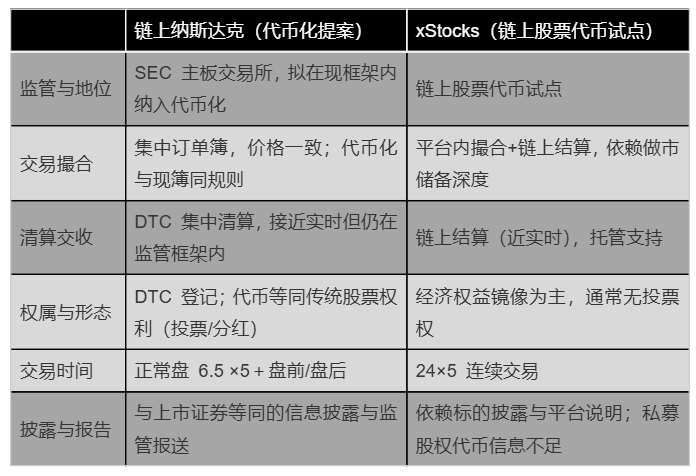
Nasdaq explicitly stipulates that a tokenized security is considered an equivalent security and can be traded on the same order book as its traditional counterpart only if it is fully homogeneous. This means that the token must be fungible with traditional shares, share the same CUSIP (Uniform Securities Identification Number), and confer upon the holder the same substantive rights and privileges as traditional shares—including rights to equity returns, dividends, voting rights, and the right to distribute residual assets upon liquidation. If the tokenized security does not confer the same rights as the original share (e.g., no voting rights, no shareholder equity), or does not share the same CUSIP, the exchange will not treat it as equivalent to the traditional security and will instead treat it as a different product, such as a derivative or American Depositary Receipt (ADR).

Because of this high standard, most so-called "tokenized stocks" currently on the market, such as Robinhood "Stock Tokens" and Xstocks, do not actually meet the above conditions. At best, they are just shadow tokens that reflect stock prices, do not represent real equity, and usually do not confer voting rights; dividends are mostly reflected in the form of reinvestment or cash equivalents; the legal relationship is mostly directed to the SPV or issuing vehicle rather than the listed company itself, and most products are mainly redeemed in cash. Direct "exchange for original shares" will be subject to custody and compliance restrictions.

2. Unified matching and distributed settlement: trading and clearing mechanism

Equity 4, Rule 4757

Nasdaq plans to fully integrate tokenized securities with traditional securities at the trading level. The proposal stipulates that as long as the tokenized version of a stock meets the aforementioned homogeneity requirements, it will share the same order book as traditional stocks and be matched according to the same order matching and priority rules. In other words, the exchange's matching engine will treat tokenized and non-tokenized buy and sell orders equally. Indeed, Nasdaq emphasizes that "at the trading stage, there is no difference between the two; the fundamental trade execution process is identical."

Equity 4, Rule 4756、4758

The difference lies in the settlement process. Currently, U.S. stock transactions are typically cleared and settled through the Depository Trust Company (DTC). By introducing tokenization, Nasdaq will offer trading participants a new option: they can use tokens for settlement. The specific process is as follows:

When brokers enter orders with the exchange, they can choose to specify that they wish to have their orders settled in tokens. If the order is executed and marked as token-settled, Nasdaq will pass the clearing instructions for the trade to DTC, which will then execute the security transfer in the background via blockchain.

DTC will register stock ownership as on-chain tokens based on its own business rules and systems (including its currently developing blockchain settlement platform). The entire process will be transparent to front-end investors. Trades will still be matched on Nasdaq, but clearing and settlement will shift from traditional electronic bookkeeping to blockchain-based registration. Ultimately, the shares will be held as tokens on-chain.

It's worth noting that Nasdaq's move isn't about creating a new market from scratch. Instead, it's leveraging existing market infrastructure, introducing blockchain as the underlying record-keeping technology without altering front-end trading mechanisms. This ensures that traditional stocks and tokenized shares maintain unified prices during trading, share market depth and liquidity, and maintain consistent information transparency and risk management. As Nasdaq explains in its filing, this plan aims to prevent different versions of tokenized shares from operating independently on multiple blockchains, fragmenting liquidity and ensuring that core mechanisms of the national market system, such as price discovery and best execution, are not impacted. This approach addresses the pain points of tokenized shares, including the lack of liquidity caused by the fragmentation of market-making capital and order books, resulting from multiple chains (ETH/SOL, etc.), multiple markets (regulated on-exchange trading versus crypto exchanges/DEXs), and geographical compliance restrictions.

3. Trading hours: 24/7 trading is not currently available

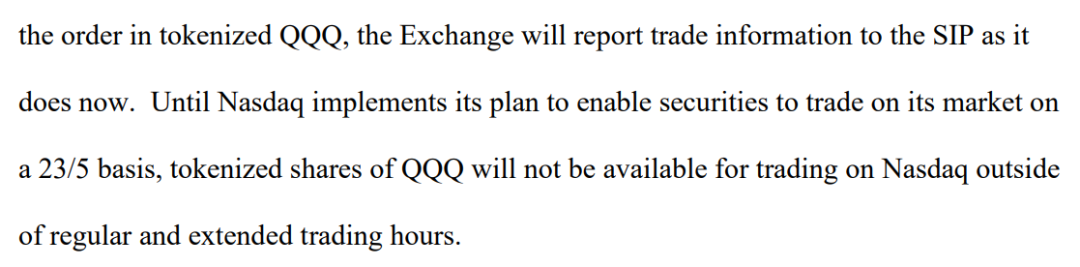
Since their launch, tokenized stocks have been plagued by issues of deep liquidity and high impact during US stock market holidays. This misalignment in trading hours has also contributed to insufficient liquidity and price decoupling. Consequently, many investors are concerned about whether tokenized stocks can transcend existing US stock market trading hours and achieve 24/7 trading. Nasdaq's proposal offers a cautious answer: at this stage, tokenized securities will only be traded during existing trading hours, with no extensions or breaks in trading hours. Tokenized stocks cannot be traded outside of regular or extended trading hours, and will continue to follow US stock market practices, trading only during regular trading hours (9:30–16:00) and pre- and post-market hours, Monday through Friday, Eastern Time. Weekend or late-night trading is not currently supported.
4. Implementation path of on-chain settlement

Nasdaq's tokenized stock trading relies on the Depository Trust & Clearing Corporation (DTC), a core clearinghouse in traditional financial markets. Notably, DTC has been exploring distributed ledger technology (DLT) clearing in recent years. Its "Project Ion" is a blockchain-based stock settlement platform designed to achieve T+0 and even real-time delivery. According to public information, Project Ion launched in a parallel pilot environment in 2022 and processes settlement instructions for over 100,000 stock trades daily. DTC developed the platform in collaboration with enterprise blockchain technology provider R3, using R3's Corda distributed ledger software and building a private permissioned blockchain as its underlying architecture. This network is a non-public consortium blockchain.

This suggests that Nasdaq's tokenized transactions are more likely to be run on DTC's permissioned blockchain platform, rather than on public blockchains such as Ethereum, which have been widely discussed in the community. This would allow DTC to maintain its legacy system as the authoritative record, running it in parallel with the new DLT system to ensure security redundancy. Therefore, under Nasdaq's proposal, on-chain settlement would likely occur within a controlled "consortium blockchain" environment, with nodes maintained by financial infrastructure operators such as DTC. This ensures transaction privacy, network reliability, and regulatory control, meeting Wall Street's high standards for trade settlement systems.

Consortium blockchains allow participants to undergo access control, ensuring greater control over data privacy and transaction speed, thus complying with regulatory requirements. Therefore, it is foreseeable that records of Nasdaq's tokenized shares will not appear on public blockchain explorers, but will instead be stored in a distributed ledger jointly maintained by Nasdaq, DTC, and related custodians. While Nasdaq has not specified the specifics of how its smart contracts will be deployed in its public documents, it is clear that Nasdaq does not intend to introduce a completely open token trading environment. Instead, it intends to utilize blockchain technology as a "behind-the-scenes" tool to enhance efficiency, while front-end transactions will still occur within a controlled system. The only change is to use blockchain records for bookkeeping. This means that investors will hold on-chain records approved by regulators, rather than crypto tokens that circulate freely outside the traditional system.
Why did Nasdaq apply for tokenized securities?

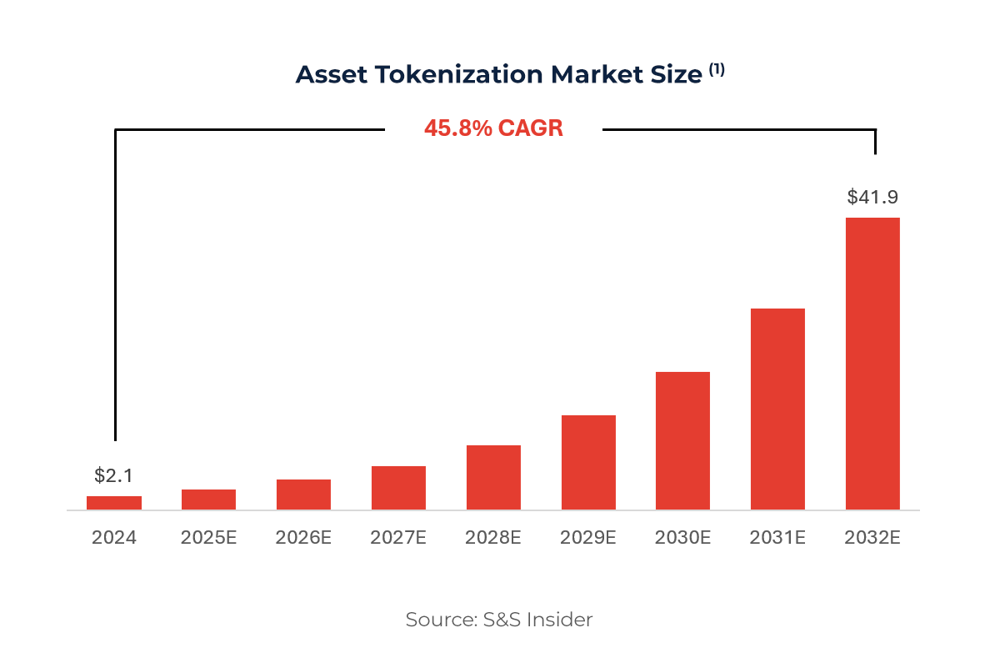
Blockchain has enormous potential to improve the efficiency of financial market infrastructure. Currently, US stock trades are settled on a delayed basis (T+1) (or T+2 in some markets). Blockchain technology can achieve near-real-time settlement (T+0 or even within seconds), reducing the time it takes for funds and securities to be held, and mitigating counterparty risk. Furthermore, blockchain's transparent and immutable distributed ledger provides a comprehensive audit trail, reducing reconciliation and manual errors. Nasdaq hopes to introduce tokenized settlement to expedite post-trade processes while reducing costs in clearing and custody. This is an attempt to revolutionize securities settlement mechanisms from the ground up. Nasdaq stated in its filing: "Today, securities, including stocks, have evolved from paper to electronic records, and tokenization is simply another method of digitally representing assets." By embracing blockchain, exchanges have demonstrated their determination to promote financial technology innovation so as not to fall behind in the new wave of technology. It is expected that the scale of the asset tokenization market is experiencing explosive growth, and the total market value of global tokenized assets will soar from approximately US$2.1 trillion in 2024 to approximately US$41.9 trillion in 2032, with a compound annual growth rate of 45.8%.
Consequently, investors and issuers are showing strong interest in security tokenization, which represents a significant emerging market opportunity. Regulators and market participants in many countries are actively exploring the potential of blockchain-based securities, and the US cannot afford to lag behind. As a market organizer, Nasdaq hopes to capitalize on this trend, offering clients new trading options and thereby attracting more capital to the US market. By taking an early approach, Nasdaq can solidify its competitiveness in the digital asset era, especially as the White House actively promotes crypto-asset innovation and fosters a digital asset-friendly regulatory environment. It is crucial to ensure that tokenized securities develop within a compliant framework and prevent market fragmentation. As mentioned earlier, many tokenized stocks are currently traded on unregulated offshore platforms, lacking investor protections. Different platforms operate independently, leading to fragmented liquidity and market opacity. Nasdaq's proposal aims to incorporate these innovations into the mainstream regulatory system, thereby preventing investors from being drawn into unregulated markets by chasing novel concepts.

While exchanges won't aggressively open up dazzling features in the short term, in the long term, stock tokenization opens up new possibilities for financial innovation. For example, stocks can be used as on-chain collateral in decentralized finance (DeFi), and equity tokens can be programmatically integrated into smart contracts to automate dividends, voting, and even the creation of entirely new derivatives and index products. These scenarios, difficult to achieve under traditional architectures, are expected to gradually become possible with tokenization. However, it's important to note that Nasdaq's tokenized securities trading venue remains on Nasdaq, meaning it's brokered within a compliant, centralized environment. This doesn't mean anyone can trade anonymously and freely on-chain.

Conclusion: Long-term opportunities and industry outlook

Nasdaq's promotion of tokenized securities trading is undoubtedly a major innovation in the underlying technology of securities trading. It marks a crucial step for traditional financial markets towards the blockchain era. From regulatory approval to technological preparation, this transformation will not be achieved overnight. According to Nasdaq's application documents, the relevant blockchain settlement infrastructure may not be ready until the end of the third quarter of 2026. Nasdaq anticipates that, assuming the proposal is approved by the SEC and the DTC's distributed ledger settlement system is launched, US investors could expect to see the first securities transactions settled in token form by the end of the third quarter of 2026.

Investors need to recognize that this is a long-term theme. The GENIUS Act ushers in a new era of stablecoin compliance, and Nasdaq tokenized securities could become the next game-changing milestone. In the coming years, policy advancements and technological milestones related to this theme will continue to be a market focus, fostering cyclical investment opportunities in sectors such as oracles and RWAs. As Nasdaq management has stated, innovation should occur within national market systems to protect investors, not in the unregulated offshore wilderness. As Nasdaq tokenized stocks gradually launch, it will unlock greater potential for institutional capital to participate in on-chain equities.

For example, large institutions can obtain real stock tokens through official channels and then confidently invest them in DeFi to generate returns. This represents a high level of capital that shadow token platforms currently struggle to attract. For the average user, once sovereign-level exchanges offer compliant stock tokens, holding shadow versions without shareholder rights becomes unnecessary.

While the prospects are promising, potential limitations must be addressed. First, in the initial stages, the direct benefits for average investors may be limited. Currently, US retail investors can easily trade stocks through brokerages, and Nasdaq's tokenization will not immediately significantly reduce their trading costs or barriers to entry. While benefits such as 24/7 trading are not necessarily desirable for non-professional investors, they may not want to be constantly trading and experiencing volatility. Smart contracts are also subject to the risk of vulnerabilities and hacking, and if problems arise with tokenized stock contracts, it remains unclear who will bear liability. Furthermore, significant price deviations have been observed in some unregulated tokenized stock transactions abroad, exposing issues of insufficient liquidity and potential manipulation. Under Nasdaq's proposal, these deviations are expected to be reduced because the tokens are backed by real stocks and traditional market makers participate in pricing.

Nasdaq's tokenized stock trading will mark a major milestone in the commercial application of blockchain technology. It signifies that blockchain is no longer confined to the cryptocurrency world, but has truly entered the core landscape of mainstream finance. From an industry perspective, this is an authoritative endorsement of the blockchain and Web3 ecosystem, inspiring more companies and developers to invest in this field. From a financial history perspective, this event may be seen as the starting point for the digital transformation of the traditional securities market, similar to the transition of exchanges from paper-based trading to electronic trading decades ago. For the Web3 community, this is an opportunity to put ideals into practice: concepts like decentralization and tokenization can only unlock their greatest value when integrated with the real economy. While this may not be the most utopian outcome for purist decentralization enthusiasts, it has significantly advanced the process of large-scale blockchain adoption.

Disclaimer: The articles reposted on this site are sourced from public platforms and are provided for informational purposes only. They do not necessarily reflect the views of MEXC. All rights remain with the original authors. If you believe any content infringes on third-party rights, please contact crypto.news@mexc.com for removal. MEXC makes no guarantees regarding the accuracy, completeness, or timeliness of the content and is not responsible for any actions taken based on the information provided. The content does not constitute financial, legal, or other professional advice, nor should it be considered a recommendation or endorsement by MEXC.

You May Also Like

The U.S. Department of Defense has appointed a former DOGE official as Chief Data Officer to lead efforts in the field of AI.

The U.S. Department of Defense has appointed a former DOGE official as Chief Data Officer to lead efforts in the field of AI.

PANews reported on March 7 that, according to Reuters, the U.S. Department of Defense has appointed computer scientist Gavin Kliger as chief data officer. Kliger
Share
PANews2026/03/07 21:00
5 Best Cryptos to Buy for 2025: Why LILPEPE Is Investors Top Pick?
5 Best Cryptos to Buy for 2025: Why LILPEPE Is Investors Top Pick?

The market is heating up as the next bull rally approaches, and investors are seeking […]
Share
Coinstats2025/09/18 12:30
Atlassian’s Monumental DX Acquisition: Revolutionizing Developer Productivity for a Billion-Dollar Future

Atlassian’s Monumental DX Acquisition: Revolutionizing Developer Productivity for a Billion-Dollar Future

BitcoinWorld Atlassian’s Monumental DX Acquisition: Revolutionizing Developer Productivity for a Billion-Dollar Future In a move that sends ripples across the tech industry, impacting everything from foundational infrastructure to the cutting-edge innovations seen in blockchain and cryptocurrency development, productivity software giant Atlassian has made its largest acquisition to date. This isn’t just another corporate buyout; it’s a strategic investment in the very fabric of how software is built. The Atlassian acquisition of DX, a pioneering developer productivity platform, for a staggering $1 billion, signals a profound commitment to optimizing engineering workflows and understanding the true pulse of development teams. For those invested in the efficiency and scalability of digital ecosystems, this development underscores the growing importance of robust tooling at every layer. Unpacking the Monumental Atlassian Acquisition: A Billion-Dollar Bet on Developer Efficiency On a recent Thursday, Atlassian officially announced its agreement to acquire DX for $1 billion, a sum comprising both cash and restricted stock. This substantial investment highlights Atlassian’s belief in the critical role of developer insights in today’s fast-paced tech landscape. For years, Atlassian has been synonymous with collaboration and project management tools, powering teams worldwide with products like Jira, Confluence, and Trello. However, recognizing a growing need, the company has now decisively moved to integrate a dedicated developer productivity insight platform into its formidable product suite. This acquisition isn’t merely about expanding market share; it’s about deepening Atlassian’s value proposition by providing comprehensive visibility into the health and efficiency of engineering operations. The strategic rationale behind this billion-dollar move is multifaceted. Atlassian co-founder and CEO Mike Cannon-Brookes shared with Bitcoin World that after a three-year attempt to build an in-house developer productivity insight tool, his Sydney-based company realized the immense value of an external, existing solution. This candid admission speaks volumes about the complexity and specialized nature of developer productivity measurement. DX emerged as the natural choice, not least because an impressive 90% of DX’s existing customers were already leveraging Atlassian’s project management and collaboration tools. This pre-existing synergy promises a smoother integration and immediate value for a significant portion of the combined customer base. What is the DX Platform and Why is it a Game-Changer? At its core, DX is designed to empower enterprises by providing deep analytics into how productive their engineering teams truly are. More importantly, it helps identify and unblock bottlenecks that can significantly slow down development cycles. Launched five years ago by Abi Noda and Greyson Junggren, DX emerged from a fundamental challenge: the lack of accurate and non-intrusive metrics to understand developer friction. Abi Noda, in a 2022 interview with Bitcoin World, articulated his founding vision: to move beyond superficial metrics that often failed to capture the full picture of engineering challenges. His experience as a product manager at GitHub revealed that traditional measures often felt like surveillance rather than support, leading to skewed perceptions of productivity. DX was built on a different philosophy, focusing on qualitative and quantitative insights that truly reflect what hinders teams, without making developers feel scrutinized. Noda noted, “The assumptions we had about what we needed to help ship products faster were quite different than what the teams and developers were saying was getting in their way.” Since emerging from stealth in 2022, the DX platform has demonstrated remarkable growth, tripling its customer base every year. It now serves over 350 enterprise customers, including industry giants like ADP, Adyen, and GitHub. What makes DX’s success even more impressive is its lean operational model; the company achieved this rapid expansion while raising less than $5 million in venture funding. This efficiency underscores the inherent value and strong market demand for its solution, making it an exceptionally attractive target for Atlassian. Boosting Developer Productivity: Atlassian’s Strategic Vision The acquisition of DX is a clear signal of Atlassian’s strategic intent to not just manage tasks, but to optimize the entire software development lifecycle. By integrating DX’s capabilities, Atlassian aims to offer an end-to-end “flywheel” for engineering teams. This means providing tools that not only facilitate collaboration and project tracking but also offer actionable insights into where processes are breaking down and how they can be improved. Mike Cannon-Brookes elaborated on this synergy, stating, “DX has done an amazing job [of] understanding the qualitative and quantitative aspects of developer productivity and turning that into actions that can improve those companies and give them insights and comparisons to others in their industry, others at their size, etc.” This capability to benchmark and identify specific areas for improvement is invaluable for organizations striving for continuous enhancement. Abi Noda echoed this sentiment, telling Bitcoin World that the combined entities are “better together than apart.” He emphasized how Atlassian’s extensive suite of tools complements the data and information gathered by DX. “We are able to provide customers with that full flywheel to get the data and understand where we are unhealthy,” Noda explained. “They can plug in Atlassian’s tools and solutions to go address those bottlenecks. An end-to-end flywheel that is ultimately what customers want.” This integration promises to create a seamless experience, allowing teams to move from identifying an issue to implementing a solution within a unified ecosystem. The Intersection of Enterprise Software and Emerging Tech Trends This landmark acquisition also highlights a significant trend in the broader enterprise software landscape: a shift towards more intelligent, data-driven solutions that directly impact operational efficiency and competitive advantage. As companies continue to invest heavily in digital transformation, the ability to measure and optimize the output of their most valuable asset — their engineering talent — becomes paramount. DX’s impressive roster of over 350 enterprise customers, including some of the largest and most technologically advanced organizations, is a testament to the universal need for such a platform. These companies recognize that merely tracking tasks isn’t enough; they need to understand the underlying dynamics of their engineering teams to truly unlock their potential. The integration of DX into Atlassian’s ecosystem will likely set a new standard for what enterprise software can offer, pushing competitors to enhance their own productivity insights. Moreover, this move by Atlassian, a global leader in enterprise collaboration, underscores a broader investment thesis in foundational tooling. Just as robust blockchain infrastructure is critical for the future of decentralized finance, powerful and insightful developer tools are essential for the evolution of all software, including the complex applications underpinning Web3. The success of companies like DX, which scale without massive external funding, also resonates with the lean, efficient ethos often celebrated in the crypto space. Navigating the Era of AI Tools: Measuring Impact and ROI Perhaps one of the most compelling aspects of this acquisition, as highlighted by Atlassian’s CEO, is its timely relevance in the era of rapidly advancing AI tools. Mike Cannon-Brookes noted that the rise of AI has created a new imperative for companies to measure its usage and effectiveness. “You suddenly have these budgets that are going up. Is that a good thing? Is that not a good thing? Am I spending the money in the right ways? It’s really, really important and critical.” With AI-powered coding assistants and other generative AI solutions becoming increasingly prevalent in development workflows, organizations are grappling with how to quantify the return on investment (ROI) of these new technologies. DX’s platform can provide the necessary insights to understand if AI tools are genuinely boosting productivity, reducing bottlenecks, or simply adding to complexity. By offering clear data on how AI impacts developer efficiency, DX will help enterprises make smarter, data-driven decisions about their AI investments. This foresight positions Atlassian not just as a provider of developer tools, but as a strategic partner in navigating the complexities of modern software development, particularly as AI integrates more deeply into every facet of the engineering process. It’s about empowering organizations to leverage AI effectively, ensuring that these powerful new tools translate into tangible improvements in output and innovation. The Atlassian acquisition of DX represents a significant milestone for both companies and the broader tech industry. It’s a testament to the growing recognition that developer productivity is not just a buzzword, but a measurable and critical factor in an organization’s success. By combining DX’s powerful insights with Atlassian’s extensive suite of collaboration and project management tools, the merged entity is poised to offer an unparalleled, end-to-end solution for optimizing software development. This strategic move, valued at a billion dollars, underscores Atlassian’s commitment to innovation and its vision for a future where engineering teams are not only efficient but also deeply understood and supported, paving the way for a more productive and insightful era in enterprise software. To learn more about the latest AI market trends, explore our article on key developments shaping AI features. This post Atlassian’s Monumental DX Acquisition: Revolutionizing Developer Productivity for a Billion-Dollar Future first appeared on BitcoinWorld.
Share
Coinstats2025/09/18 21:40
