BitcoinWorld From scooters to satellites: How a former mobility founder raised $5M to build data centers in space Euwyn Poon, the founder who built and sold e-BitcoinWorld From scooters to satellites: How a former mobility founder raised $5M to build data centers in space Euwyn Poon, the founder who built and sold e-

From scooters to satellites: How a former mobility founder raised $5M to build data centers in space

2026/06/10 04:40
5 min read
For feedback or concerns regarding this content, please contact us at crypto.news@mexc.com

BitcoinWorld

From scooters to satellites: How a former mobility founder raised $5M to build data centers in space

Euwyn Poon, the founder who built and sold e-scooter company Spin to Ford in 2018, has raised $5 million in seed funding for a far more ambitious venture: putting AI data centers in orbit. The startup, called Orbital, emerged from a16z’s Speedrun accelerator in May with backing from a16z and a roster of investors including Basis Set, Human Element, Wayfinder, Antler, Anti Fund, Ascent, and others. The company is betting that SpaceX’s Starship will eventually make the economics of space-based compute viable — a gamble shared by a growing number of startups in the nascent sector.

A familiar pitch, a new frontier

Orbital’s core premise is straightforward: demand for AI compute is exploding, and terrestrial data centers face constraints in power, cooling, and permitting. Space offers unlimited solar energy and minimal regulatory friction. The catch, as Poon readily acknowledges, is that launching hardware into orbit remains prohibitively expensive with current rockets. “We will get to full scale when Starship comes online,” Poon told Bitcoin World. “The price of the Falcon 9 makes this not economically feasible.”

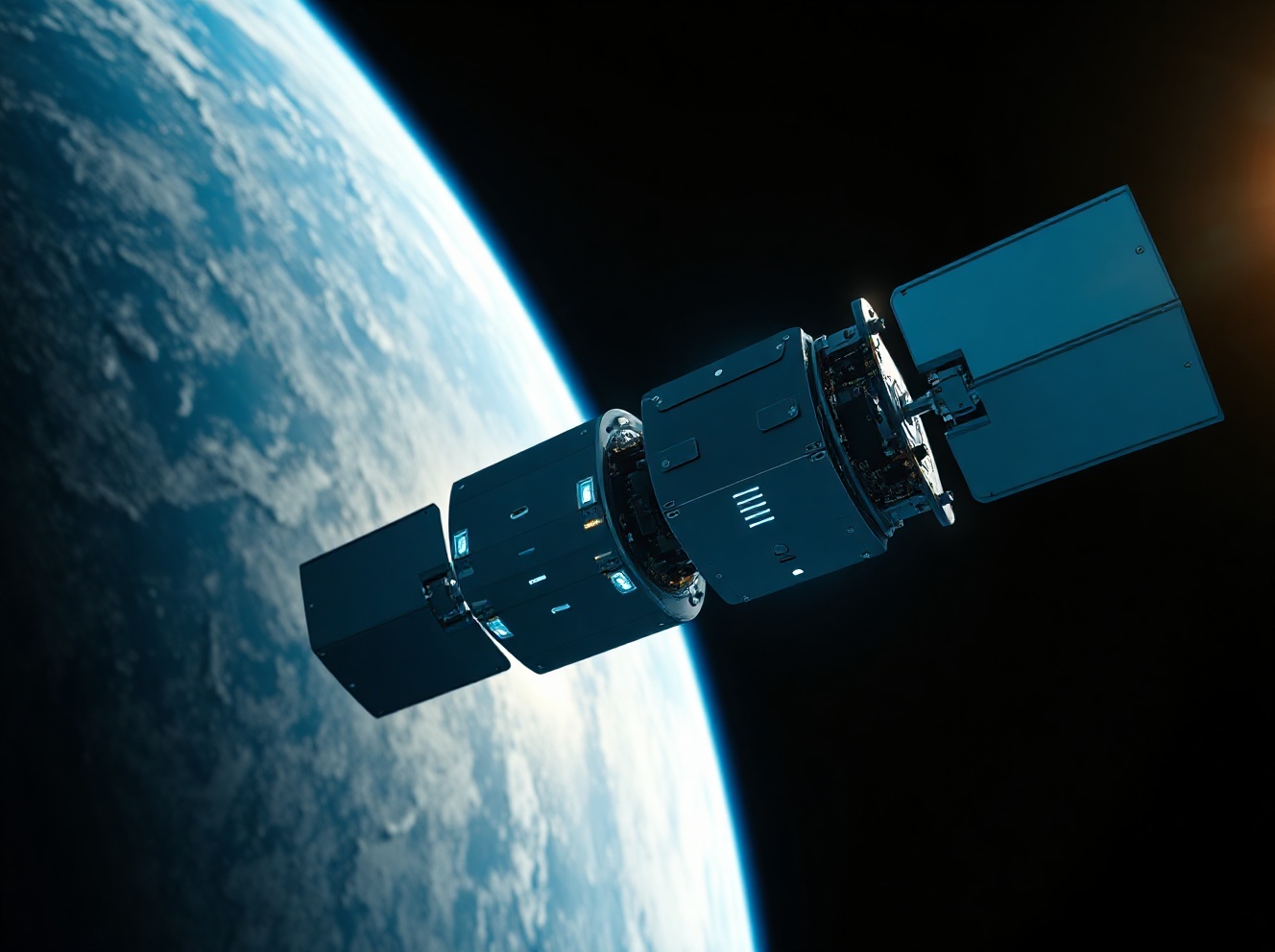
For now, the company — a team of about a dozen engineers in Los Angeles with backgrounds at Amazon’s LEO satellite project, SpaceX, and Northrop Grumman — is focused on a demo flight. Orbital plans to fly an Nvidia Blackwell chip on a partner’s satellite to test its radiation shielding and thermal management technology. The company’s roadmap targets 2028 for the launch of its first dedicated data-processing spacecraft, equipped with Nvidia’s Space-1 Vera Rubin-class GPUs. At that point, Orbital expects to begin generating revenue through piece-wise inference work, with each satellite contributing to a distributed computing network.

Betting big on Starship — and patience

Orbital’s long-term goal is to deploy 10,000 satellites providing a distributed gigawatt of computing power, with each satellite rated at 100 kW. For context, Elon Musk has said SpaceX expects its own AI satellites to produce up to 150 kW, while rival Starcloud plans 200 kW-rated spacecraft. The capital requirements are staggering — Poon estimates the full buildout could take a decade and cost $5 billion or more.

But venture investors, once skittish about long-duration, capital-intensive space bets, have grown more comfortable. a16z partner Andrew Chen, who worked with Poon through Speedrun, noted that Poon’s experience scaling Spin — deploying 250,000 scooters across 100 cities — demonstrated the operational rigor needed for aerospace. “This kind of thing would have sounded crazy 10 years ago when we were all building mobile apps,” Chen said. “Starting it in 2026 just lets you tap into all the energy and excitement happening in the capital markets.”

Competitors and impatience

Orbital is not alone. Starcloud already has a GPU in orbit and plans to launch more before Starship arrives. Cowboy Space Company, another a16z-backed startup, grew impatient and decided to build its own rockets. Jeff Bezos’ Blue Origin has also announced plans to launch data centers using its New Glenn vehicle. Poon is unfazed by the competition. “There’s so many lanes for companies in our space to pursue,” he said, citing different AI workloads, satellite designs, and operational concepts as opportunities for multiple winners.

How a scooter founder ended up in space

Poon’s path to space data centers was unconventional. After leaving Ford, he bought an Nvidia A100 GPU on a whim, co-located it in a Santa Clara data center, and began serving open-weight AI models. That hands-on experiment convinced him that the real value in the AI boom lies in delivering compute — not just building models. Now he faces the challenge of putting thousands of GPUs into orbit, a task that will test both his engineering instincts and his ability to raise capital at scale.

Conclusion

Orbital represents a bet that the space industry’s cost curve will bend sharply downward, driven by Starship’s reusability. If that bet pays off, the company could be among the first to offer orbital AI processing as a commercial service. If Starship is delayed, Orbital — like its competitors — will have to survive on demo missions and investor patience. Either way, the fact that a former scooter entrepreneur can raise $5 million for a space data center startup says as much about the current venture climate as it does about the technology.

FAQs

Q1: What is Orbital’s business model?
Orbital plans to launch satellites equipped with Nvidia GPUs to perform AI inference in space. The company will sell compute capacity to customers who need low-latency processing for satellite imagery, remote sensing, or other orbital applications.

Q2: Why does AI compute need to go to space?
Space offers unlimited solar power, no land-use restrictions, and faster permitting compared to terrestrial data centers. For applications where data is already generated in orbit — such as Earth observation — processing in space reduces latency and bandwidth costs.

Q3: How is Orbital different from Starcloud or Cowboy Space Company?
Orbital is focused on deploying a large constellation of smaller, 100 kW-class satellites, while Starcloud targets larger 200 kW spacecraft. Cowboy Space Company has chosen to develop its own launch vehicle rather than wait for Starship. All three are pursuing the same fundamental opportunity but with different technical and go-to-market strategies.

This post From scooters to satellites: How a former mobility founder raised $5M to build data centers in space first appeared on BitcoinWorld.


Market Opportunity
Spacecoin Logo
Spacecoin Price(SPACE)
$0.006233
$0.006233$0.006233
-4.82%
USD
Spacecoin (SPACE) Live Price Chart

Predict & Trade to Win Rewards

Predict & Trade to Win RewardsPredict & Trade to Win Rewards

Guaranteed rewards with $500,000 prize pool

Disclaimer: The articles reposted on this site are sourced from public platforms and are provided for informational purposes only. They do not necessarily reflect the views of MEXC. All rights remain with the original authors. If you believe any content infringes on third-party rights, please contact crypto.news@mexc.com for removal. MEXC makes no guarantees regarding the accuracy, completeness, or timeliness of the content and is not responsible for any actions taken based on the information provided. The content does not constitute financial, legal, or other professional advice, nor should it be considered a recommendation or endorsement by MEXC.

You May Also Like

Why Businesses Need Professional Machine Design and Development Services

Why Businesses Need Professional Machine Design and Development Services

In many industries, machines are the backbone of daily work. They help businesses speed up production, improve accuracy, and reduce manual effort. But building
Share
Techbullion2026/04/02 17:54
Bitcoin liquidation wave reveals AI trade pulling capital from crypto

Bitcoin liquidation wave reveals AI trade pulling capital from crypto

AI becomes the rival trade to Bitcoin Bitcoin’s latest weakness has unfolded as investors reassess where the strongest speculative returns are coming from. In a
Share
The Crypto Updates2026/06/10 12:17
Lovable AI’s Astonishing Rise: Anton Osika Reveals Startup Secrets at Bitcoin World Disrupt 2025

Lovable AI’s Astonishing Rise: Anton Osika Reveals Startup Secrets at Bitcoin World Disrupt 2025


BitcoinWorld Lovable AI’s Astonishing Rise: Anton Osika Reveals Startup Secrets at Bitcoin World Disrupt 2025 Are you ready to witness a phenomenon? The world of technology is abuzz with the incredible rise of Lovable AI, a startup that’s not just breaking records but rewriting the rulebook for rapid growth. Imagine creating powerful apps and websites just by speaking to an AI – that’s the magic Lovable brings to the masses. This groundbreaking approach has propelled the company into the spotlight, making it one of the fastest-growing software firms in history. And now, the visionary behind this sensation, co-founder and CEO Anton Osika, is set to share his invaluable insights on the Disrupt Stage at the highly anticipated Bitcoin World Disrupt 2025. If you’re a founder, investor, or tech enthusiast eager to understand the future of innovation, this is an event you cannot afford to miss. Lovable AI’s Meteoric Ascent: Redefining Software Creation In an era where digital transformation is paramount, Lovable AI has emerged as a true game-changer. Its core premise is deceptively simple yet profoundly impactful: democratize software creation. By enabling anyone to build applications and websites through intuitive AI conversations, Lovable is empowering the vast majority of individuals who lack coding skills to transform their ideas into tangible digital products. This mission has resonated globally, leading to unprecedented momentum. The numbers speak for themselves: Achieved an astonishing $100 million Annual Recurring Revenue (ARR) in less than a year. Successfully raised a $200 million Series A funding round, valuing the company at $1.8 billion, led by industry giant Accel. Is currently fielding unsolicited investor offers, pushing its valuation towards an incredible $4 billion. As industry reports suggest, investors are unequivocally “loving Lovable,” and it’s clear why. This isn’t just about impressive financial metrics; it’s about a company that has tapped into a fundamental need, offering a solution that is both innovative and accessible. The rapid scaling of Lovable AI provides a compelling case study for any entrepreneur aiming for similar exponential growth. The Visionary Behind the Hype: Anton Osika’s Journey to Innovation Every groundbreaking company has a driving force, and for Lovable, that force is co-founder and CEO Anton Osika. His journey is as fascinating as his company’s success. A physicist by training, Osika previously contributed to the cutting-edge research at CERN, the European Organization for Nuclear Research. This deep technical background, combined with his entrepreneurial spirit, has been instrumental in Lovable’s rapid ascent. Before Lovable, he honed his skills as a co-founder of Depict.ai and a Founding Engineer at Sana. Based in Stockholm, Osika has masterfully steered Lovable from a nascent idea to a global phenomenon in record time. His leadership embodies a unique blend of profound technical understanding and a keen, consumer-first vision. At Bitcoin World Disrupt 2025, attendees will have the rare opportunity to hear directly from Osika about what it truly takes to build a brand that not only scales at an incredible pace in a fiercely competitive market but also adeptly manages the intense cultural conversations that inevitably accompany such swift and significant success. His insights will be crucial for anyone looking to understand the dynamics of high-growth tech leadership. Unpacking Consumer Tech Innovation at Bitcoin World Disrupt 2025 The 20th anniversary of Bitcoin World is set to be marked by a truly special event: Bitcoin World Disrupt 2025. From October 27–29, Moscone West in San Francisco will transform into the epicenter of innovation, gathering over 10,000 founders, investors, and tech leaders. It’s the ideal platform to explore the future of consumer tech innovation, and Anton Osika’s presence on the Disrupt Stage is a highlight. His session will delve into how Lovable is not just participating in but actively shaping the next wave of consumer-facing technologies. Why is this session particularly relevant for those interested in the future of consumer experiences? Osika’s discussion will go beyond the superficial, offering a deep dive into the strategies that have allowed Lovable to carve out a unique category in a market long thought to be saturated. Attendees will gain a front-row seat to understanding how to identify unmet consumer needs, leverage advanced AI to meet those needs, and build a product that captivates users globally. The event itself promises a rich tapestry of ideas and networking opportunities: For Founders: Sharpen your pitch and connect with potential investors. For Investors: Discover the next breakout startup poised for massive growth. For Innovators: Claim your spot at the forefront of technological advancements. The insights shared regarding consumer tech innovation at this event will be invaluable for anyone looking to navigate the complexities and capitalize on the opportunities within this dynamic sector. Mastering Startup Growth Strategies: A Blueprint for the Future Lovable’s journey isn’t just another startup success story; it’s a meticulously crafted blueprint for effective startup growth strategies in the modern era. Anton Osika’s experience offers a rare glimpse into the practicalities of scaling a business at breakneck speed while maintaining product integrity and managing external pressures. For entrepreneurs and aspiring tech leaders, his talk will serve as a masterclass in several critical areas: Strategy Focus Key Takeaways from Lovable’s Journey Rapid Scaling How to build infrastructure and teams that support exponential user and revenue growth without compromising quality. Product-Market Fit Identifying a significant, underserved market (the 99% who can’t code) and developing a truly innovative solution (AI-powered app creation). Investor Relations Balancing intense investor interest and pressure with a steadfast focus on product development and long-term vision. Category Creation Carving out an entirely new niche by democratizing complex technologies, rather than competing in existing crowded markets. Understanding these startup growth strategies is essential for anyone aiming to build a resilient and impactful consumer experience. Osika’s session will provide actionable insights into how to replicate elements of Lovable’s success, offering guidance on navigating challenges from product development to market penetration and investor management. Conclusion: Seize the Future of Tech The story of Lovable, under the astute leadership of Anton Osika, is a testament to the power of innovative ideas meeting flawless execution. Their remarkable journey from concept to a multi-billion-dollar valuation in record time is a compelling narrative for anyone interested in the future of technology. By democratizing software creation through Lovable AI, they are not just building a company; they are fostering a new generation of creators. His appearance at Bitcoin World Disrupt 2025 is an unmissable opportunity to gain direct insights from a leader who is truly shaping the landscape of consumer tech innovation. Don’t miss this chance to learn about cutting-edge startup growth strategies and secure your front-row seat to the future. Register now and save up to $668 before Regular Bird rates end on September 26. To learn more about the latest AI market trends, explore our article on key developments shaping AI features. This post Lovable AI’s Astonishing Rise: Anton Osika Reveals Startup Secrets at Bitcoin World Disrupt 2025 first appeared on BitcoinWorld.


Share
Coinstats2025/09/17 23:40

RealStocks Now Live

RealStocks Now LiveRealStocks Now Live

Trade real U.S. stock via regulated brokerage