Monero (XMR) outlook – Bears still in charge, but a short-term bounce is getting real

Price action is shaped by a dominant downtrend on the higher timeframe, while Monero attempts a tactical short-term recovery inside a still fragile structure.
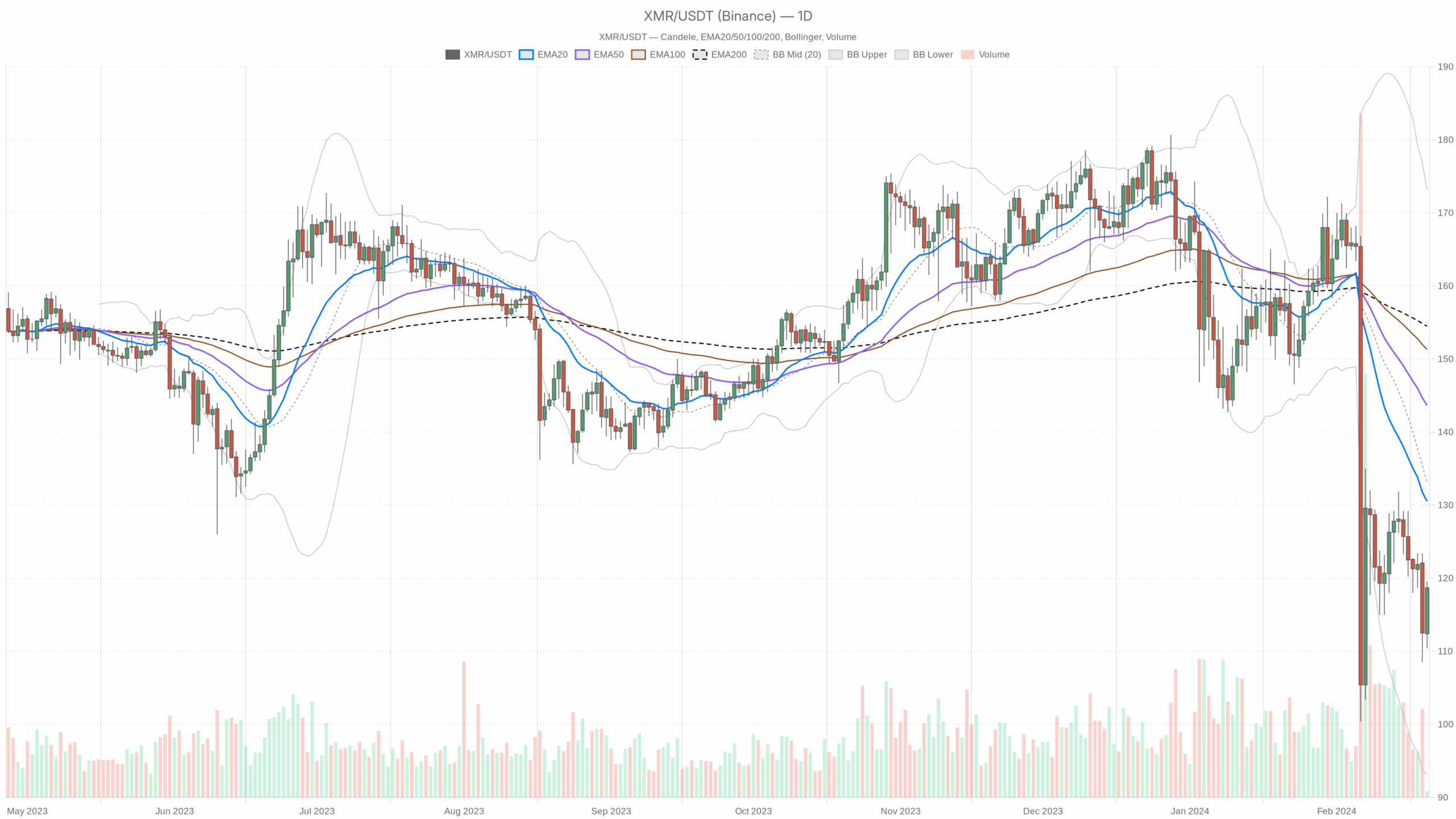 XMR/USDT — daily chart with candlesticks, EMA20/EMA50 and volume.
Monero (XMR) – Where We Stand Now
Monero is trading around $118.7 against USDT, deep inside a medium-term downtrend but with a noticeable short-term rebound trying to build from below. Daily structure is still clearly bearish, yet lower timeframes show growing risk appetite and an attempt to squeeze shorts.
This is a classic moment where trend and mean reversion are fighting each other: the dominant direction is still down on the daily chart, but 1H and 15m momentum are pushing up from oversold territory. In other words, the path of least resistance is still lower, but the market is no longer willing to sell at any price.
Given the current readings, the main scenario on D1 is bearish, with a tactical bullish countertrend phase underway intraday.
Daily Chart (D1) – Bears Control the Trend
On the daily timeframe, Monero is in a mature downtrend. Price is trading below all key moving averages and under the Bollinger mid-band, with volatility still meaningful and the sentiment backdrop in Fear.
Trend Structure – EMA Cluster
- Price: $118.7
- EMA 20: $130.53
- EMA 50: $143.65
- EMA 200: $154.49
All three EMAs are stacked above price and above each other (20 < 50 < 200) with a clear downward slope. Price sitting almost $12 below the 20-day EMA confirms a bearish regime where rallies are, by default, suspect.
What it implies: Structurally, XMR is still in a downtrend. Any bounce toward $130–145 is, for now, a potential selling zone until the daily closes start reclaiming the 20-day EMA and flattening the 50-day.
Momentum – RSI & MACD
- RSI 14 (D1): 38.32
RSI below 40 shows bearish momentum, but not outright capitulation. Sellers are in control, yet the market is not extremely oversold anymore. That usually fits with a market that has already taken a hit and is now in a pause or bounce phase.
What it implies: Downside pressure dominates, but the easy part of the selloff is probably behind us. This is a zone where countertrend longs can appear, but they are fighting the primary trend.
- MACD (D1): line -9.66, signal -8.97, histogram -0.69
MACD is negative, with the line slightly below the signal and a small negative histogram. That is consistent with a bearish trend, but note the histogram magnitude is modest. Downside momentum is real, but not accelerating hard.
What it implies: The downtrend is active but not in waterfall mode. Bears still own the higher timeframe, yet they are not pressing the gas further at this exact moment, which leaves room for short-covering rallies.
Volatility & Range – Bollinger Bands and ATR
- Bollinger Bands (D1): mid $133.1, upper $173.11, lower $93.1
- ATR 14 (D1): $10.34
Price at $118.7 sits below the mid-band and in the lower half of the band range, but not hugging the lower band. The band width is wide ($93–173), signalling an already volatile environment. ATR around $10 points to sizeable daily swings, so moves of 7–10% in a single session are entirely normal here.
What it implies: The market has already expanded lower and is still volatile. That often leads to two-phase behavior: first trend, then choppy mean reversion while volatility bleeds out. We are likely somewhere between those two stages.
Key Daily Levels – Pivots
- Pivot Point (PP): $116.23
- Resistance 1 (R1): $122.07
- Support 1 (S1): $112.87
Price at $118.7 is trading above the daily pivot but below R1.
What it implies: Today’s balance is slightly positive versus the reference level, but XMR is still capped beneath the first resistance band. Bulls have intraday control, yet they have not broken the daily downtrend context.
1-Hour Chart (H1) – Countertrend Bounce with Work to Do
On the 1H chart, Monero is transitioning from defensive to more neutral positioning, with some early signs of short-term accumulation.
Trend & Structure – EMAs
- Price: $118.7
- EMA 20 (H1): $115.86
- EMA 50 (H1): $118.31
- EMA 200 (H1): $122.02
Price is trading above the 20- and 50-hour EMAs, but still below the 200-hour EMA. The shorter EMAs are starting to curl up, while the 200-hour remains a heavy cap overhead.
What it implies: Intraday, buyers have taken the wheel from the recent lows, but they are still driving against a broader downtrend. The 200-hour EMA near $122 and the daily R1 around $122 create a confluence barrier. That is the first major line where this bounce will be tested.
Momentum – RSI & MACD
- RSI 14 (H1): 56.78
RSI is comfortably above 50 but not overbought, matching a healthy intraday upswing.
What it implies: Bulls have momentum on this timeframe, but there is still room to push higher before exhaustion sets in. This favors continuation of the bounce as long as the market stays above the intraday EMAs.
- MACD (H1): line -1.71, signal -2.00, histogram 0.29
The MACD line is still below zero, but it has crossed above the signal with a positive histogram. This setup is typical of a rebound within a wider downtrend.
What it implies: Short-term momentum is shifting to the upside, but the move is corrective in nature until MACD pushes into positive territory and holds there.
Volatility & Short-Term Levels – Bollinger, ATR, Pivots
- Bollinger Bands (H1): mid $116.28, upper $124.46, lower $108.1
- ATR 14 (H1): $3.77
- Pivot Point (H1): $117.4
- R1 (H1): $120.9
- S1 (H1): $115.2
Price is sitting just above the mid-band and above the hourly pivot, heading toward the upper band zone around $124. Volatility is moderate on this timeframe, with about $3–4 expected hourly range.
What it implies: Near-term control leans toward buyers, with the first serious intraday resistance between $120.9 (H1 R1) and $122 (daily R1 / H1 200 EMA). A clean break there would upgrade this from a simple bounce to a more meaningful short-term trend change.
15-Minute Chart (M15) – Overheated Execution Zone
The 15-minute chart is where we see the immediate heat of this bounce, and it is already running hot.
Short-Term Trend – EMAs
- Price: $118.7
- EMA 20 (M15): $114.02
- EMA 50 (M15): $114.5
- EMA 200 (M15): $118.12
Price is trading sharply above the 20- and 50-EMA and just above the 200-EMA on the 15m chart.
What it implies: Very short term, buyers have clearly taken over. However, the spread between price and the fast EMAs is wide, which usually does not last. Either price cools off or it goes into a volatile chop while the averages catch up.
Local Momentum – RSI & MACD
- RSI 14 (M15): 71.14
RSI above 70 on the 15-minute shows overbought intraday conditions.
What it implies: The move up is strong but stretched. From an execution standpoint, this is a poor spot to initiate fresh longs. It is more a zone where short-term traders either trim or wait for a pullback.
- MACD (M15): line 0.71, signal 0.11, histogram 0.60
MACD is positive with the line above the signal and a strong positive histogram.
What it implies: Immediate momentum is decisively bullish on this micro timeframe. Combined with overbought RSI, it points to a powerful thrust that is increasingly vulnerable to a shakeout or consolidation.
Very Short-Term Range – Bollinger, ATR, Pivots
- Bollinger Bands (M15): mid $113.61, upper $116.71, lower $110.52
- ATR 14 (M15): $2.06
- Pivot Point (M15): $117.77
- R1 (M15): $120.53
- S1 (M15): $115.93
Price at $118.7 is trading above the mid-band and above the 15m pivot, and already through the upper band from earlier in the session.
What it implies: The short-term battle is won by the bulls, but the combination of band extension and high RSI usually precedes a pause. Hourly ATR around $3–4 and 15m ATR near $2 warn that intraday swings can be sharp both ways.
Market Context – Risk Appetite in a Bearish Shell
The broader crypto market cap sits around $3.22T, up roughly 1.5% in the last 24h, with BTC dominance above 57%. The Fear & Greed Index is at 26 (Fear) as of 2026, reflecting a still cautious environment.
What it implies for Monero:
We have a market that is leaning risk-on over the last 24 hours, but sentiment is still defensive overall. In that environment, privacy coins like Monero often lag on strong BTC-led legs and then catch part of the move via short-covering bounces. That fits well with what we are seeing in the multi-timeframe picture: higher timeframe bearish, short-term recovery, cautious risk-taking.
Bullish Scenario for XMR
For bulls, the current play is a countertrend recovery that might graduate into a larger reversal if key levels flip.
Near-term (intraday) path:
- Hold above the daily pivot at $116.23 and the H1 pivot at $117.4.
- 15m RSI cools from overbought (70+) back toward 50–60 via sideways price or a shallow pullback, while price remains above the M15 200 EMA (~$118.1) or at worst the H1 50 EMA (~$118.3).
Upside checkpoints:
- $120.9–$122: confluence of H1 R1, daily R1, and H1 200 EMA. A clean 1H close above this band would signal that buyers have done more than just squeeze shorts.
- From there, the next technical magnet on the daily chart is the 20-day EMA around $130.5.
What confirms a more meaningful bullish swing:
- A daily close above $130–133 (20-day EMA and Bollinger mid-band) would indicate that the market is starting to attack the medium-term downtrend rather than just bounce within it.
- RSI on D1 pushing back above 45–50 and MACD histogram flattening toward zero would support the idea of a trend transition.
Invalidation of the bullish scenario:
- A sustained move back below $116 (under daily and H1 pivots) would show that the bounce has failed.
- A daily close below $112.87 (S1) would put the bears firmly back in control and opens the door to a re-test of the lower Bollinger area toward $100–95.
Bearish Scenario for XMR
Bears still own the higher timeframe, and the primary thesis is that rallies get sold until proven otherwise.
Core bearish view:
- Daily EMAs remain stacked bearish and far above price, with RSI below 40 and MACD negative. That is the backbone of the downtrend.
- The current intraday strength is treated as a short-covering rally into resistance, not a new bull trend, unless key levels are reclaimed.
Bearish roadmap:
- Price fails to hold the $120.9–$122 resistance pocket (H1 R1 / daily R1 / H1 200 EMA) and starts rejecting from that zone.
- 15m RSI rolls down from overbought and breaks below 50, while the M15 200 EMA at $118.1 and H1 50 EMA at $118.3 give way.
- A decisive break back below $116.23 (daily PP) turns today’s structure from constructive to vulnerable.
Downside targets from there:
- First, $112.87 (daily S1) as an immediate support zone.
- If that breaks on a daily close, price opens a window toward the lower half of the Bollinger range, with the lower band down near $93 acting as the extreme bearish extension.
What invalidates the bearish dominance:
- Multiple daily closes back above the 20-day EMA (~$130.5), ideally followed by a flattening or turn-up of the 50-day around $143–145.
- D1 RSI sustainably above 50 and MACD crossing its signal with the histogram turning positive.
Until those conditions appear, the broader bias remains bearish, and rallies into the EMA cluster on the daily chart are technically countertrend. At the same time, this phase can still host sharp rallies, especially if the broader market maintains a modest risk-on tone.
How to Think About Positioning Right Now
Monero is caught between a dominant daily downtrend and a live intraday bounce. Higher timeframe traders will still call this a bear market rally; lower timeframe traders will treat it as an opportunity-rich environment with big intraday ranges.
Key tensions to keep in mind:
- Trend vs. Mean Reversion: the daily trend is down. Fading every spike has worked recently, but as price extends away from the EMAs, bounces like this become sharper. That is where mean reversion traders step in.
- Momentum vs. Structure: M15 and H1 momentum is bullish, but it is operating inside a bearish daily structure. Strong short-term signals against the higher timeframe trend tend to be shorter-lived unless backed by real structural breaks.
- Risk Appetite vs. Defense: the broader market is recovering with BTC dominance high and sentiment in Fear. That usually means capital is selective. Privacy coins like Monero will not be the first in line for aggressive risk-on flows, but they can still move hard when liquidity is thin.
In practical terms, this is a phase where chasing on the 15-minute after an overbought spike is risky. Markets can whipsaw intraday as the bounce runs into higher timeframe resistance. Position size and stop placement matter more than usual given the elevated ATR on both daily and intraday charts.
Any plan, bullish or bearish, should respect the fact that volatility is high and the main trend is still down. Intraday traders may lean into the current bounce with tight risk, while swing traders will be more interested in how price behaves around $122 and especially $130–133 before changing their broader bias on Monero.
Open your Investing.com account
This section contains a sponsored affiliate link. We may earn a commission at no additional cost to you.
This analysis is for informational and educational purposes only and does not constitute investment, trading, or financial advice. Markets for Monero (XMR) and other cryptocurrencies are highly volatile and risky. Always conduct your own research and consider your risk tolerance before making any trading decisions.
In summary, Monero remains locked in a higher timeframe downtrend while pursuing an active intraday rebound, creating a landscape where tactical opportunities exist but trend risk is still clearly skewed to the downside.
You May Also Like

FCA, crackdown on crypto

Bitcoin struggles at $113K as Fed's Bowman hints at faster rate cuts
Bitcoin traders revealed new BTC price bottom targets as BTC price action wobbles, while a dovish Fed speech offered bulls little relief. Key points:Bitcoin faces problems recovering from its dip to $112,000 as traders agree on the odds of a fresh dip.Nasdaq Performance is on the radar as overheated RSI conditions raise concerns over a crypto knock-on effect. Read more