

Teodoro at Shangri-La: PH as convergence point for regional security?
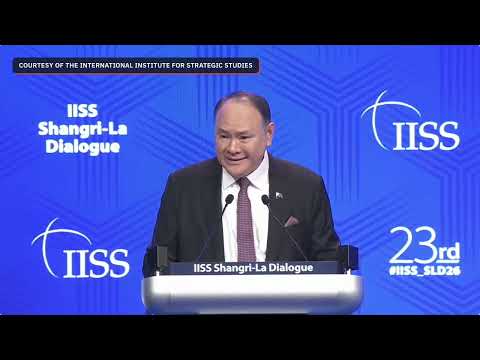
SINGAPORE – Of almost all speeches made during the six plenary sessions of the International Institute for Strategic Studies (IISS) at the Shangri-La Dialogue, it was the speech of Defense Secretary Gilberto Teodoro Jr. that, perhaps, triggered the most murmurs and discussions among delegates after delivery.
It was a strong speech — as the spitfire of a defense chief is wont to deliver — especially before premiere platforms like the Shangri-La, Asia’s top defense summit.
“As strategic sentinel, we will stand watch over our sovereign rights and entitlement. And as guardian of freedom of the seas, we will stand watch with the international community for this part of the world,” Teodoro said on Sunday, May 31, during the final plenary session titled, “Evolving Security Partnerships in a Fragmented World.”
The pitch to an audience of fellow defense ministers and officials, top military brass, the academe, and media from all over Southeast Asia and beyond was simple: that the Philippines, because it stands by international law and because of its vast network of partners, is a convergence point for a “fragmented world.”
It’s a concept that builds on earlier articulations of the Philippines’ place in the world — or at least the country’s aspirations for its place in the world — throughout the current Marcos administration.
Addressing the Australian Parliament in 2024, President Ferdinand Marcos Jr. presented the Philippines as the frontline country in upholding international law, norms, and rules in Asia. Months later, during the 2024 Shangri-La Dialogue, Marcos urged middle powers to come together while, and precisely because, the superpowers are duking it out for dominance in the region and in the rest of the world.

Teodoro explained this concept — a brainchild of maritime law expert Jay Batongbacal — based on four points:
The Philippines’ confidence and resolve. The archipelagic nation, said its defense secretary, would uphold the “absolute integrity” of its land, sea, and air rights and entitlements based on international law, including the United Nations Convention on the Law of the Sea (UNCLOS).
At the core of the Philippines’ foreign and domestic policies on the West Philippine Sea is its sovereign rights being rooted in UNCLOS and being affirmed by the 2016 Arbitral Award, which found invalid China’s supposed historical basis for claiming almost all of the South China Sea.
The country’s moral ascendancy and international reputation. Because Manila grounds its claims and actions on international law, Teodoro argued, the international community stands by the Philippines. Several countries, especially those with close strategic and defense ties with the Philippines, have long supported the 2016 Arbitral Award and its implementation.
“Like-minded nations,” Philipine military chief General Romeo Brawner Jr. said at a breakout session in Shangri-La, means support of the landmark award. It’s a list that has grown longer since 2023, or when the Philippines started exposing China’s aggressive actions in the West Philippine Sea.
Commitment to ASEAN centrality. Among the core principles of the Association of Southeast Asian Nations, which Manila happens to chair in 2026, is ASEAN Centrality or the idea that in dreaming up a future of the region and the world, ASEAN members should think of the bloc, and not just themselves.
It’s a principle that’s easier said than done when what’s added to the mix is required consensus in the bloc and the wide array of interests, alignments, and foreign policies in the 11-member regional grouping.
Manila’s efforts to back all that up with deterrence capability. The Armed Forces of the Philippines (AFP) modernization efforts as we know it now started after 2012, or the standoff between the Philippines and China in Scarborough Shoal.
More than a decade later, modernization continues to be slow but steady. It’s also been made possible by the Philippines’ growing list of defense and security partners — vessels from Japan and the United States, funding or aid from the same countries, and joint training operations on land and sea with countries like the US, Japan, Australia, Canada, New Zealand, and France, among others.
Forefront of fragmentation
In speaking about the Philippines and fragmentation, Teodoro does so in concrete terms.
By virtue of geography and its history, Manila finds itself a middle power in the literal middle of tensions in the South China Sea, the competition between China and the US, and fear of hostilities erupting in the Taiwan Strait. Since the start of the US and Israel’s war on Iran in February 2026, Filipinos have had to deal with the shocks of rising energy prices and the cost of goods following disruptions in oil supply after the Strait of Hormuz closed down.
In the past and especially under Marcos, Manila’s solution has been to both double down on its existing ties — a Mutual Defense Treaty with the US, and robust relations with Japan and Australia, among others — while also looking for partners in all corners of the world, as long as they’re like-minded in support of the 2016 Arbitral Award.
That, understandably, means Manila’s relationship with Beijing has been difficult.
Tensions over the South China Sea is one thing — and they continue. As Teodoro and Brawner were speaking at Shangri-La, the military was confirming new structures in Scarborough Shoal, which China has controlled access to since the 2012 standoff. Officials Rappler spoke to said based on initial checks, these were likely new structures — and not the ones the Philippine military installed then abandoned back in the early 2000s.
It’s an unenviable context to have as Manila navigates a Code of Conduct on the South China Sea as ASEAN chair.
It is also this context that makes Teodoro’s warning on negotiating with China especially interesting. “For the PRC, therefore, in the Philippine experience, negotiations are therefore not a path to conflict resolution but a means of gaining advantage,” said Teodoro.
Filipino diplomats have been working double time to improve diplomatic ties with China since taking on the ASEAN chairmanship in 2026. Bilateral meetings have taken place again, after long lulls.
Both Teodoro and the Philippine military have been consistent in their skepticism towards China — the lingering gap of trust. It’s easy to understand the distrust. These security and defense offiicals have under them the frontliners of the West Philippine Sea — the Philippine Coast Guard, Navy, and Air Force personnel, among others, who patrol the seas and sky in areas that China insists is theirs.
The call for convergence, especially among middle powers and smaller nations, is now a new cry.
Marcos has said this before, in a different and, in restrospect, a much more stable time all but two years ago. “We are not mere bystanders to unfolding world events. We are the actors that drive those events. We are the main characters in our collective story. We are the owners of the narratives of our regional community,” said Marcos before the Shangri-La Dialogue in 2024.
Canada’s Mark Carney has expressed a less optimistic version of this view, in warning middle powers of being on the menu if they’re not on the table. – Rappler.com


You May Also Like

How to Spot a South African Cyber-Scam Before You Click “Pay”
When the Cloud burns: What Iran’s AWS strikes mean for African fintech
Rappler Recap: Senate majority skips session again; minority seeks Cayetano’s resignation


Trending News
More24/7 Live News
More
