While crypto has sold off into quarter-end, one of the industry's biggest players is making a very different bet: turning gold into on-chain credit. Tether, the issuer of the largest stablecoin, is partnering with crypto lender Ledn to let holders of its tokenized gold token, XAUT, borrow against their bullion without selling it. The deal, confirmed by Tether CEO Paolo Ardoino, puts Tether's roughly $23 billion physical gold reserve at the center of a new lending push.
It is a notable moment for real-world assets (RWA) in crypto: one of the oldest stores of value, gold, becoming active digital collateral. With the crypto Fear & Greed Index in Extreme Fear and Bitcoin back below $60,000, a less volatile form of collateral has obvious appeal. Here is what XAUT gold-backed loans actually are, how they work, why Tether is doing this, and the important catches to understand.
Key Takeaways
Tether is partnering with crypto lender Ledn to let holders of Tether Gold (XAUT) borrow stablecoins against their tokenized gold, without selling it; the loans are expected to launch later in 2026.
XAUT is backed 1:1 by physical gold, with each token representing one troy ounce stored in Swiss vaults; about 707,747 ounces back the circulating supply (a market cap near $2.5 billion).
Tether holds roughly 140 metric tons of physical gold (about $23 billion), making it one of the world's largest corporate gold holders, and is building a broader gold business.
The model mirrors Ledn's long-running Bitcoin-backed loans, and Ledn says it never rehypothecates collateral, a 1:1 custody policy meant to avoid the mistakes that sank 2022-era lenders.
Gold is far less volatile than Bitcoin, which could mean lower liquidation risk and friendlier loan-to-value terms, an attractive feature in a fearful market.
The catches: terms (rates, LTV, minimums) are not yet public, the product excludes EU and Canada residents, and Tether has never completed a full independent audit.
What Are XAUT Gold-Backed Loans?
On June 18, Ledn announced, and Ardoino confirmed, that XAUT will be supported on Ledn's platform alongside Bitcoin, USDT, and Tether's newer USAT token, with gold-backed loans to follow later in 2026. The idea is simple: instead of selling your
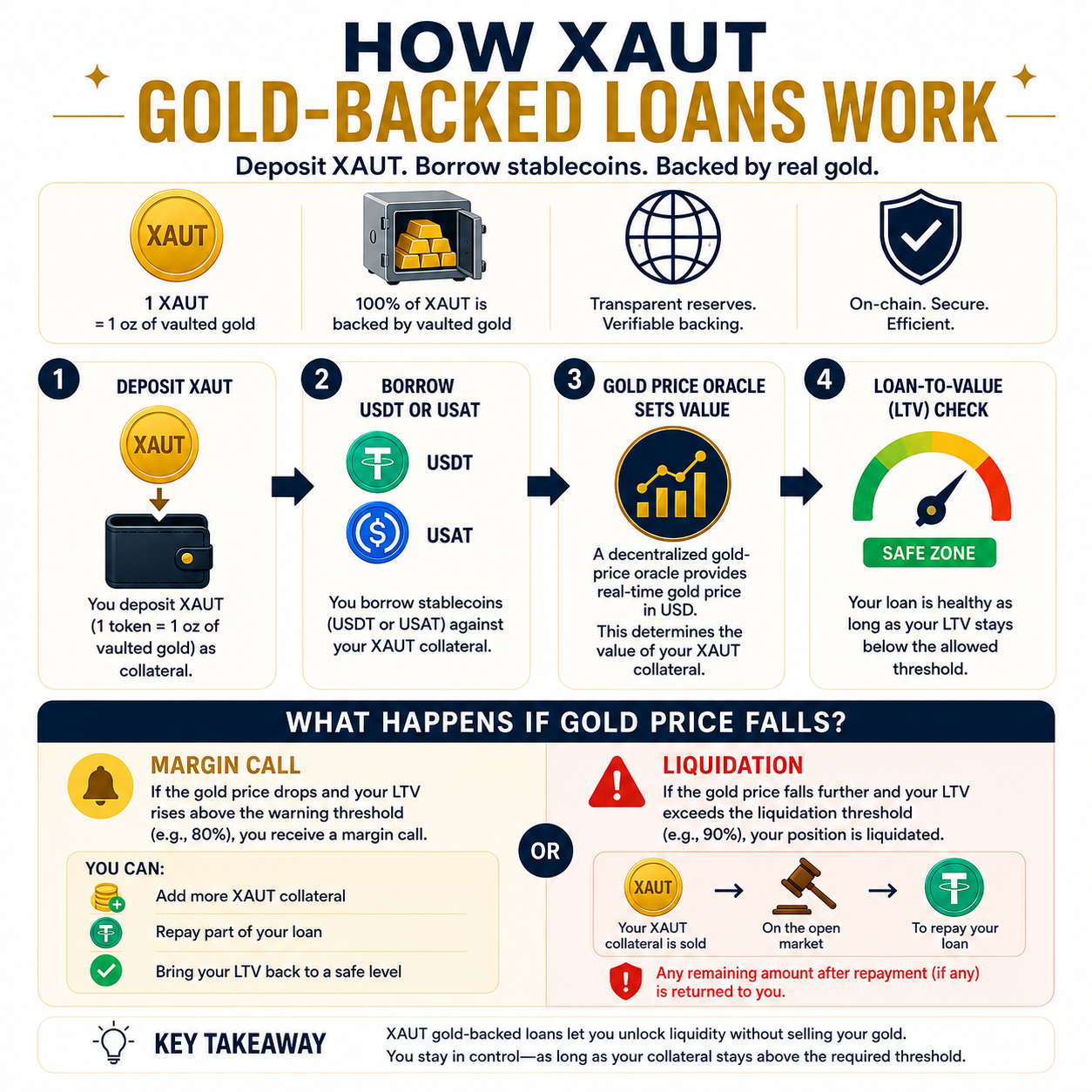
tokenized gold to raise cash, you pledge it as collateral and borrow stablecoins against it. That lets holders access liquidity without giving up ownership of the gold, and without triggering a taxable sale. It mirrors the Bitcoin-backed loans Ledn has offered for years, now extended to a different kind of asset. XAUT itself is straightforward: each token represents one fine troy ounce of physical gold held in Swiss vaults, with roughly 707,747 ounces currently backing the same number of tokens, a market value near $2.5 billion.
How It Works, and the Risks
The mechanics follow a familiar collateralized-lending playbook. You deposit XAUT, the platform assigns a loan-to-value (LTV) limit, and you borrow stablecoins (USDT or USAT) against it. A price oracle feeds the gold spot price to the platform, and if gold falls far enough that your loan breaches the LTV threshold, you face a margin call and, if you cannot add collateral or repay, liquidation. Ledn's key safeguard is its 1:1 custody policy: it says client collateral is never lent out or rehypothecated to generate extra yield, the practice that distinguished it from lenders like Celsius, BlockFi, and Voyager that collapsed in 2022. One advantage of gold over Bitcoin as collateral is volatility: gold moves far less, which could translate into lower liquidation risk and more favorable LTV ratios, a meaningful draw in a market where sentiment sits in Extreme Fear. The caveats are real, though. Rates, LTV ratios, and minimum amounts have not been disclosed, the product will not be available to residents of the EU or Canada (a consequence of Tether's stance on Europe's MiCA rules), and Tether has never completed a full independent audit, relying instead on point-in-time attestations.
Why Tether Is Doing This
The Ledn deal is one piece of a much larger gold strategy. Tether has accumulated roughly 140 metric tons of physical bullion, worth about $23 billion, making it one of the world's largest corporate gold holders, and it has invested in the precious-metals marketplace Gold.com and partnered with crypto financier Antalpha to expand XAUT's use in lending and physical redemption. Just a day before the Ledn announcement, on June 17, Tether wound down its synthetic dollar Alloy and aUSDT to consolidate around XAUT as its core gold product. The broader goal is to turn a passive reserve into productive collateral, and it fits Tether's transformation, funded by profits from the world's largest stablecoin, into a diversified group spanning finance, energy, Bitcoin mining, and AI infrastructure.
Why It Matters for RWA and Crypto
This is a concrete use case for real-world assets on-chain: gold, one of the oldest stores of value, becoming functional digital collateral rather than a passive token. Tokenized gold has been a growing RWA category, and a lending integration pushes XAUT from a digital certificate toward genuine financial infrastructure, bridging traditional wealth and crypto markets. It is also a sign of stablecoin issuers evolving into diversified financial firms, which raises fresh questions for regulators about oversight as these companies take on more complex roles. Notably, XAUT's closest tokenized-gold competitor, Paxos Gold (PAXG), does not yet offer a comparable lending feature, so Tether is moving first.
How to Get Exposure on MEXC
For crypto users who want gold exposure without a bank or a bullion dealer, tokenized gold offers a digital way to hold and trade the metal's price. On MEXC, you can track and trade
XAUT and other tokenized-asset and RWA tokens, using gold as a potential diversifier alongside more volatile crypto. As always, know exactly what you hold: XAUT tracks the gold price (steadier than Bitcoin, but not risk-free), and any future borrowing against it adds liquidation risk on top. If the lending product interests you, watch for the eventual loan terms and confirm your jurisdiction is eligible before committing.
Conclusion
Tether's move to put its gold reserve to work is a milestone for tokenized real-world assets: it turns XAUT from a digital gold certificate into something you can actually borrow against, mirroring the Bitcoin-backed loans that have become a crypto staple. In a nervous, risk-off market, gold's relative stability as collateral is a genuine draw. But the product is not live yet, key terms are unknown, it is off-limits in the EU and Canada, and Tether's lack of a full audit remains a fair question. Tokenized gold is becoming real financial infrastructure, just keep your eyes open as the details arrive.
Disclaimer: This content is for educational and reference purposes only and does not constitute any investment advice. Digital asset investments carry high risk. Please evaluate carefully and assume full responsibility for your own decisions.