Overview
Global semiconductor and infrastructure enterprise software provider
Broadcom (NASDAQ: AVGO) is scheduled to release its fiscal third-quarter financial results for 2026 on Wednesday, September 2, following the close of standard US equity market trading. Holding a critical position across the accelerated computing supply chain alongside Nvidia, Broadcom enters this earnings window near all-time valuation highs. According to consensus forecasts compiled by
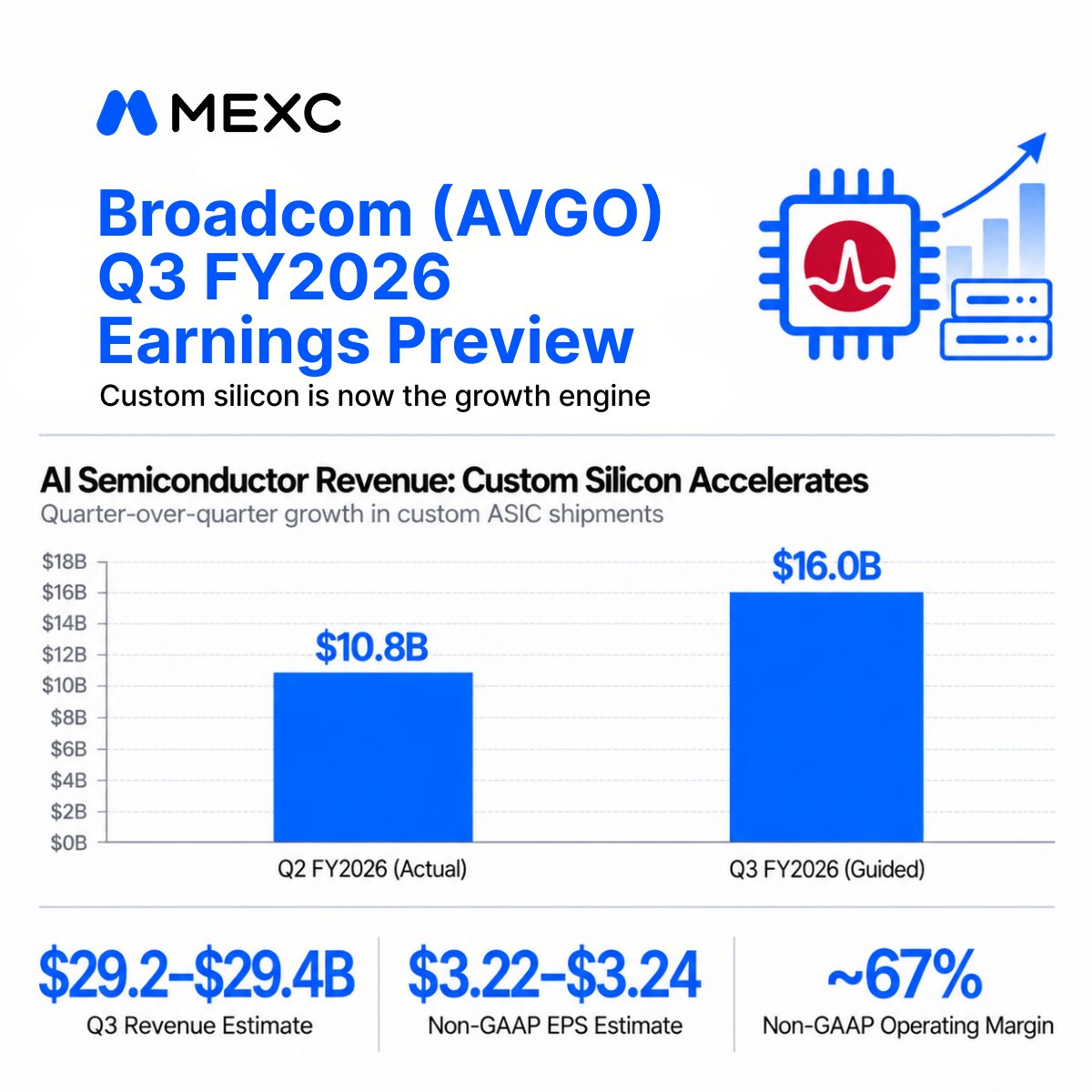
Reuters, Wall Street expects third-quarter net revenue to reach between $29.2 billion and $29.4 billion, representing a year-over-year expansion of roughly 84%, alongside Non-GAAP diluted earnings per share (EPS) of $3.22 to $3.24, marking an increase of over 90% from the prior-year period. As cloud hyperscalers accelerate their transition toward custom application-specific integrated circuits (ASICs and XPUs) to bypass high graphics processing unit hardware premiums and energy constraints, Broadcom has guided its quarterly artificial intelligence semiconductor sales toward $16.0 billion. Market participants are primarily focused on whether flagship custom accelerators deployed for
Alphabet and
Meta can sustain upside revenue beats, and whether executive management will lift fiscal 2027 artificial intelligence revenue projections toward the milestone $100 billion benchmark.

Key Takeaways
Quarterly financial metrics face elevated expansion benchmarks as Wall Street consensus models project fiscal third-quarter revenue between $29.2 billion and $29.4 billion alongside Non-GAAP EPS of $3.22 to $3.24, reflecting 84% and 91% annualized growth rates respectively.
Custom silicon operations represent the central growth engine with third-quarter AI semiconductor revenue guided to roughly $16.0 billion, a 200% year-over-year surge driven by accelerating deployments of Google TPU architectures and Meta MTIA accelerators.
Advanced networking switching fabrics expand infrastructure defensibility through high-throughput Tomahawk 5 and Jericho 3-AI platforms alongside co-packaged optical systems, establishing open Ethernet fabrics as standard connectivity across hyperscale clusters.
VMware integration generates robust recurring free cash flow as the transition of enterprise virtualization workloads toward VMware Cloud Foundation subscription licensing yields high double-digit annualized recurring revenue expansion.
Product mix shifts recalibrate gross margins and operating leverage, where higher volume shipments of custom hardware ASICs modestly compress headline gross margin percentages while expanding aggregate operating cash flows to record highs.
Consensus Expectations and Growth Benchmarks: The $29.4 Billion Revenue Hurdle
Across the
Nasdaq, Broadcom serves as a foundational barometer for institutional capital deployment into customized computing hardware.
Baseline Consensus Estimates and Operating Efficiency
Regulatory filings submitted to the
U.S. Securities and Exchange Commission show that Broadcom recorded revenue of approximately $22.2 billion and Non-GAAP EPS of $2.44 during the preceding fiscal quarter, outperforming sell-side expectations. For the third quarter, financial models aggregated by Bloomberg place aggregate net revenue between $29.24 billion and $29.40 billion. Operating margins on a Non-GAAP basis are projected to hold near 67%, underscoring the company's ability to maintain tight operating leverage while scaling capital-intensive physical hardware delivery across global data centers.
The $16 Billion AI Semiconductor Benchmark
Within the broader revenue mix, the AI semiconductor division is expected to expand from $10.8 billion in the second quarter to roughly $16.0 billion, reflecting an annualized expansion rate of roughly 200%. Analysis from
Bloomberg indicates that Broadcom's quarterly AI hardware sales now surpass the total annual revenues of most legacy semiconductor manufacturers. Because valuation multiples have expanded in tandem with hardware expectations, market participants require actual revenue deliveries to exceed $16.5 billion to support immediate post-earnings momentum.
The Custom Silicon Transition: Why Hyperscalers Prioritize ASIC Architectures
Global data center infrastructure is undergoing a structural shift from homogeneous GPU computing to heterogeneous environments where customized silicon handles dedicated inference and structured training workloads.
Google remains Broadcom's foundational custom ASIC partner, with volume fabrication of sixth-generation and seventh-generation Tensor Processing Units (TPUs) anchoring quarterly hardware shipments. Concurrently, Meta is accelerating internal rollouts of its second-generation and third-generation MTIA accelerators to support recommendation pipelines and large language model inference. Investigative reporting from the
Financial Times underscores that custom silicon optimized for targeted neural network architectures delivers significant energy efficiency and total cost of ownership advantages over standard computing cards, prompting cloud operators to allocate expanding capital expenditure budgets toward dedicated ASIC programs.
Expanding Commercial Pipelines and Physical Design Moats
Beyond existing tier-one relationships, institutional investors are tracking prospective partnerships with emerging foundation model laboratories, including exploratory discussions involving
OpenAI. Broadcom maintains significant engineering moats derived from its intellectual property portfolio in high-speed SerDes interconnects, High Bandwidth Memory (HBM) physical interfaces, and multi-die packaging. Even when enterprise customers design custom software architectures internally, they partner with Broadcom to manage physical packaging, system verification, and foundry integration with
TSMC across advanced 3nm and 2nm manufacturing nodes.
AI Networking and Switching: Ethernet Replaces Proprietary Fabrics
In hyperscale distributed compute environments, networking architectures serve as the primary physical bridge governing collective processor utilization.
Tomahawk 5 and Jericho 3-AI Market Dominance
As individual AI cluster sizes scale toward one hundred thousand accelerators, packet loss and network tail latency create substantial computational bottlenecks. Broadcom's 51.2 Tbps Tomahawk 5 switching processors and Jericho 3-AI fabrics utilize advanced congestion notification algorithms to maintain lossless data transmission. Reporting from
CNBC highlights that enterprise data center operators are increasingly deploying standard, multi-vendor high-throughput Ethernet topologies over proprietary InfiniBand fabrics due to lower procurement costs and open architectural flexibility.
Optical Interconnects and Co-Packaged Optics Integration
In addition to discrete switching silicon, Broadcom holds a leading technology position in co-packaged optics (CPO) and PCIe Gen 5/6 switching bridges. As rack-scale power densities increase, electrical copper cabling encounters physical transmission boundaries, accelerating the commercial adoption of optical interconnects. Broadcom's integration of optical engines directly onto processor substrates reduces electrical impedance and optical conversion losses, establishing essential hardware infrastructure for future multi-megawatt computing campuses.
Investors actively evaluating semiconductor cycles and technology equity derivatives can track specialized institutional liquidity venues to execute risk-managed strategies.
Furthermore, market depth metrics on
MEXC show elevated volume retention across equities-linked assets during major corporate earnings announcements.
The VMware Software Flywheel: Software Recurring Cash Flows Offset Hardware Cycles
Unlike pure-play hardware peers, Broadcom's acquisition and restructuring of VMware establishes a balanced dual-engine operating model combining high-growth hardware with high-margin infrastructure software.
Subscription Model Migration and Annualized Recurring Revenue
Following the formal integration of VMware, management transitioned the business from perpetual licensing agreements to a multi-year subscription model centered on VMware Cloud Foundation (VCF). While this transition required contract renegotiations, it substantially expanded customer lifetime contract value. Corporate filings indicate that enterprise renewal rates across private cloud virtualization suites remain robust, driving annualized recurring revenue (ARR) higher at double-digit rates.
Free Cash Flow Buffers Protect Capital Intensity
From a corporate finance perspective, high-volume custom ASIC manufacturing requires significant working capital to procure leading-edge foundry wafers and high-bandwidth memory stacks, which can exert downward pressure on consolidated gross margins. However, VMware generates operating margins in excess of 70%, providing non-dilutive, predictable free cash flows that self-fund semiconductor research and development without relying on high-cost debt issuance.
Downside Risks and Forward Monitoring Checkpoints
While structural industry tailwinds remain constructive, market participants must monitor several operational and competitive risk variables ahead of the earnings release:
Customer diversification and dual-sourcing friction, tracking whether anchor clients like Google allocate secondary custom chip or optical component contracts to competitors such as
Marvell to mitigate supply chain concentration.
Fiscal 2027 artificial intelligence guidance revisions, evaluating whether executive leadership formally raises full-year 2027 AI semiconductor revenue targets toward or above $100 billion to justify elevated forward earnings multiples.
Cyclical recovery velocity across non-AI legacy semiconductor divisions, verifying whether enterprise storage, broadband access, and industrial networking units demonstrate verified inventory troughing and positive year-over-year revenue inflections.
Advanced packaging allocation constraints at TSMC, monitoring whether monthly CoWoS wafer allocations remain sufficient to sustain planned volume shipments across next-generation customized compute programs.
Exclusive View from James Mitchell
From a quantitative market structure and liquidity framework perspective, Broadcom's upcoming earnings release on September 2 represents a definitive test of the market transition from generic hardware computing toward customized silicon ecosystems.
Many retail market participants misinterpret expanding custom ASIC revenues as a negative development due to modest gross margin dilution, failing to appreciate the superior capital velocity and absolute operating cash flow generation inherent in dedicated enterprise silicon programs. In quantitative valuation modeling, custom ASICs create architectural switching costs that are substantially higher than those associated with off-the-shelf accelerators. By combining customized compute engines with Tomahawk 5 Ethernet networking and VMware's recurring enterprise software cash flows, Broadcom functions as a diversified tollbooth across modern computing infrastructure. Derivatives positioning shows that implied volatility is pricing a standard single-digit earnings move, indicating an orderly consolidation of shares following recent technical pullbacks. The critical forward indicator is whether management provides tangible guidance toward a $100 billion annual AI semiconductor run-rate for fiscal 2027. Confirmation of that growth trajectory will support further multiple expansion across long-term institutional portfolios.
FAQ
Broadcom is scheduled to release its fiscal third-quarter 2026 financial results on Wednesday, September 2, 2026, after the close of standard US equity markets, followed by an executive conference call to review financial performance, custom silicon demand, and forward guidance.
Consensus estimates project total quarterly revenue between $29.2 billion and $29.4 billion, reflecting roughly 84% year-over-year growth, with Non-GAAP diluted earnings per share expected at $3.22 to $3.24 and AI semiconductor division revenues projected near $16.0 billion.
A custom application-specific integrated circuit (ASIC / XPU) is a tailored semiconductor designed specifically for unique artificial intelligence workloads. Compared to standard graphics processors, custom ASICs provide higher energy efficiency and lower total cost of ownership for high-volume inference and training, positioning Broadcom as the primary design partner for cloud hyperscalers like Google and Meta.
How does Broadcom maintain market dominance in AI networking?
Broadcom leads the networking sector through its high-throughput Tomahawk and Jericho switching chip architectures, which offer 51.2 Tbps bandwidth, dynamic congestion management, and co-packaged optical integration. These open-standard Ethernet solutions form the backbone of modern hyperscale artificial intelligence clusters.
The integration of VMware provides Broadcom with high-margin, sticky annualized recurring revenue from enterprise private cloud subscriptions. Generating operating margins above 70%, VMware produces substantial free cash flows that balance the cyclicality and capital intensity of semiconductor hardware manufacturing.
What key forward metrics should investors track during the earnings call?
Investors should focus on whether third-quarter AI semiconductor revenues exceed the $16.0 billion baseline, forward fiscal 2027 AI revenue guidance, enterprise VMware subscription renewal rates, and inventory stabilization across non-AI broadband and storage segments.
Disclaimer
The information, analysis, and views contained in this article are provided for general educational and informational purposes only and do not constitute financial advice, investment advice, legal advice, tax advice, or a recommendation to buy or sell any security, digital asset, or financial derivative. Equity securities and financial instruments are subject to high market volatility and capital risk. Past operational performance, financial results, and quantitative indicators do not guarantee future market returns. Investors must conduct independent due diligence and evaluate their personal financial situation, risk tolerance, and investment goals before executing any trade. The MEXC Crypto Pulse team assumes no liability for any direct or indirect financial losses resulting from the use of or reliance upon the information published herein.
About the Author
James Mitchell specializes in technical analysis, market trends, and trading strategies for both Bitcoin and altcoins. Based in London, he has over 10 years of experience in financial markets. Before joining MEXC Learn, James worked as a senior analyst at a leading European investment firm, where he developed expertise in risk management and quantitative trading. His transition to cryptocurrency markets began in 2017, and he has since become recognized for his data-driven approach. He holds a Master's degree in Financial Economics from the London School of Economics. His analytical approach combines traditional technical analysis with on-chain metrics to provide readers with actionable insights.
Areas of Expertise:
Research References